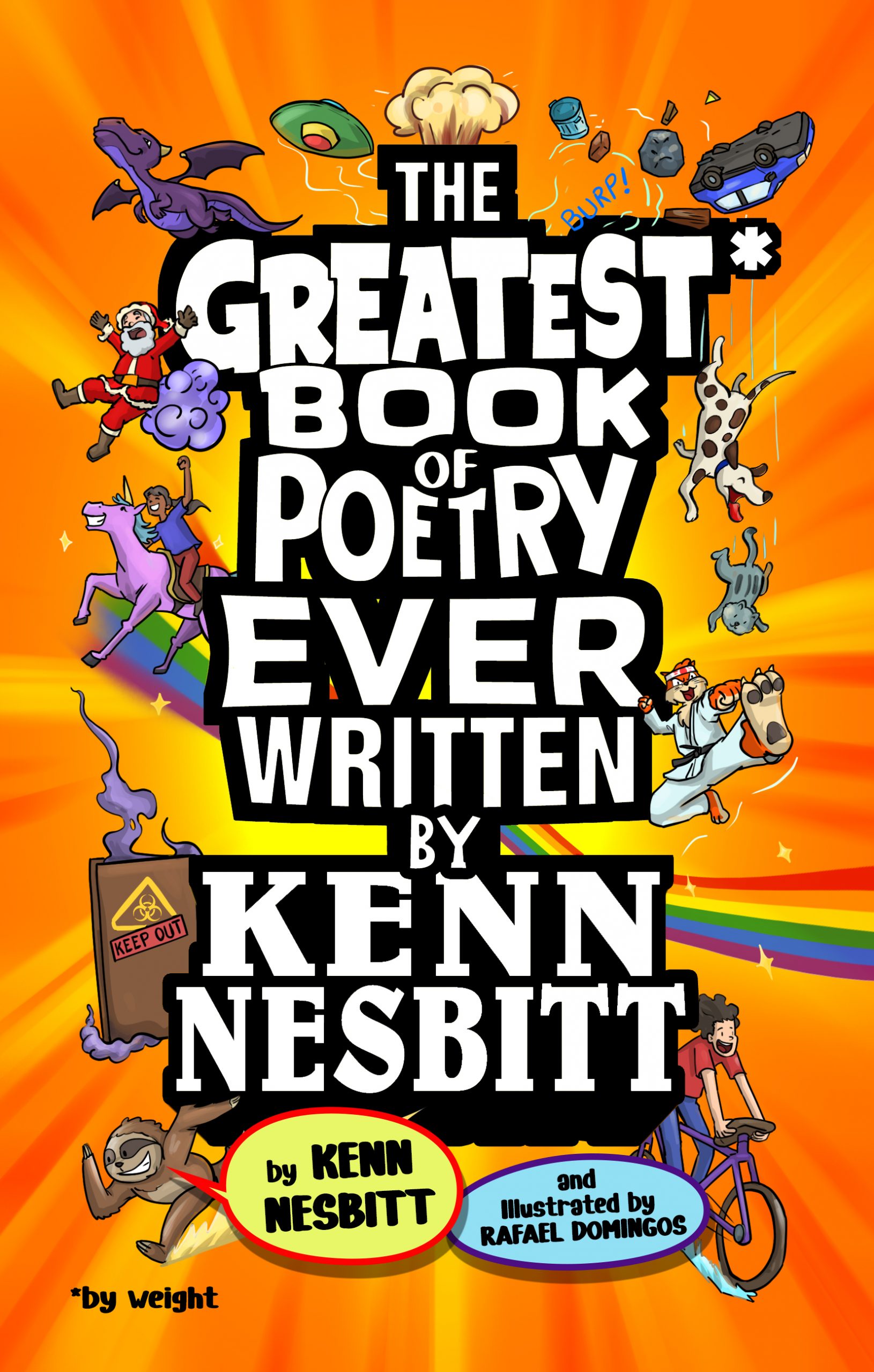
Kenn Nesbitt, former U.S. Children's Poet Laureate, is celebrated for blending humor and heart in his poetry for children. Known for books such as "My Cat Knows Karate" and "Revenge of the Lunch Ladies," he captivates young readers globally.
I love a good joke and I love a good limerick. This poem isn’t quite a limerick because the first line doesn’t rhyme with the second and fifth lines, but it’s close; it has the same rhythm and length, and almost the same rhyme scheme. So, it’s almost a limerick.
And it’s also a pretty good joke, if I do say so myself. At a recent school visit, I recited this poem to a group of third and fifth graders. The fifth graders all got it right away. It took some of the third graders a minute, but once they got it, they all laughed.
If you’re in third grade or younger and you don’t get the joke, feel free to ask a parent or older sibling to explain it. Once you get the joke, I think you’ll laugh too.
I washed our dad’s car with my sister,
to clean off the grime and the grunge.
My sister got mad and
complained to our dad and
asked, “Why can’t he just use a sponge?”
When I was in elementary school, I spent a lot of time learning to make silly faces and strange voices.
I taught myself how to wiggle my ears, raise one eyebrow at a time, and pucker my lips like a fish.
I learned how to talk like Donald Duck and Mickey Mouse and Dracula. I practiced purring and meowing to my cat. I even learned how to burp whenever I want.
About ten years ago, I even wrote an entire poem, called “My Excellent Education,” about all these crazy things I learned in school (even thought they weren’t what I was supposed to be studying). In fact, “My Excellent Education” is one of the few poems I’ve written that is almost entirely true.
Today’s poem, “I’ve Started Learning Honkish,” is specifically about the kinds of noises I liked to make–mooing, honking, burping, and so on—plus a bunch more that I just made up.
I even gave them names. I mean, if Spanish is what they speak in Spain, Norwegian is what they speak in Norway, and Chinese is what they speak in China, why can’t you speak Burpish, Snorwegian, and Garglese?
If you like this poem, why not see if you can invent a few new languages from the crazy sounds you can make and maybe even add a stanza or two of your own to this poem?
I’ve Started Learning Honkish
I’ve started learning Honkish.
It’s my favorite language now.
I’m also learning Mooish.
I can speak just like a cow.
I’m learning Chirpish, Burpish,
Beepish, yes, and Sneezanese,
and a dialect of Buzzish
so I sound just like the bees.
My dad taught me Snorwegian,
plus some Ancient Garglese,
and I’m fluent in a dozen other
languages like these.
I’m something of prodigy
where language is concerned,
except for ones the language teacher
says I should have learned.
She tried to teach me Spanish,
French, and German, but I’m lazy.
And, anyway, I’d rather learn
the ones that drive her crazy.
List poems can be so much fun to write. All you need is a beginning and an end, and then you can make a list in the middle as long or as short as you like. Shel Silverstein’s poem “Sick” and Jack Prelustky’s “Bleezer’s Ice Cream” are a couple of classic examples of list poems. I have also written quite a few list poems, including “The Games in My Room,” “Advice from Dracula,” and “My Mother Said to Do My Chores.”
While most of my poems are humorous, this one, called “Mammals,” isn’t meant to be funny. I just wanted to create a list of different mammals to show how varied they are, and yet what they mostly have in common. You might even find a few mammals you haven’t heard of on this list, such as the numbat (an endangered marsupial that eats nothing but termites), the kob (a kind of antelope), or the echidna (a spiny anteater).
You might also notice that, in addition to being a list poem, this poem also includes a fair bit of alliteration; words that start with the same consonant sounds. This is intentional, as I think it makes the poem more fun to read or listen to.
But, of course, you don’t have to write your own list poems to enjoy reading or listening to them. I hope you enjoy this one.
Mammals
Celebrate the wondrous mammal:
Bison, beaver, cheetah, camel,
panther, panda, pygmy shrew,
chimpanzee, and caribou,
weasel, wolf, raccoon, and rat,
badger, bandicoot, and bat,
rhino, reindeer, rabbit, ram,
llama, leopard, lion, lamb,
elk, echidna, hamster, hog,
marmot, meerkat, dolphin, dog,
lemur, lemming, bobcat, bear,
walrus, wombat, hippo, hare,
kob, koala, kangaroo,
naked mole rat, numbat, gnu,
aardvark, ape, orangutan,
mongoose, manatee, and man.
These and more are in the family,
furry, four-limbed, warm, and mammally.
For several years now I have been doing live, interactive webinars in conjunction with Streamable Learning, the leading provider of interactive livestreams in the K-12 market in the US and Canada. Through quality educational content and an easy-to-use platform, Streamable Learning aims to in introduce interactive livestreams as a valuable supplemental tool for classrooms and families seeking to inspire and educate their K-12 students.
During the 2019-20 school year, I will be providing 35 online webinars, including interactive poetry-writing lessons, holiday poetry sessions, and programs on famous children’s poets from Dr. Seuss to Shel Silverstein. Schools are invited to join any of these sessions as my guest, completely free of charge.
Streamable Learning and Zoom
If you haven’t yet used Zoom, I think you’re going to love it. Zoom is a free videoconferencing program similar to Skype, but with clearer, more reliable audio and video.
Streamable Learning offers a convenient, cost-effective, and comprehensive calendar of interactive livestreams delivered by subject matter experts and designed to supplement your existing and future lesson plans. To discover hundreds of engaging, educational programs, have a look a their Livestream Calendar.
I have been offering interactive poetry livestreams through Streamable Learning for several years now, and I hope you’ll be able to join me this year. There is no cost for this; you can register for free and participate in as many of these upcoming sessions as you like.
To register, simply click on the links in the schedule below for the sessions you would like to join.
If you would prefer to arrange a private interactive videoconference for your class or school only, simply click here to schedule an online author visit. I look forward to seeing your students online!
When you repeat the first words of each line, what you end up with is not only a repetition poem, but a list poem as well. For example, my poem “I’ll Never,” repeats those words at the beginning of nearly every line of the poem, forming a list of all the things I’ll never do.
Forget that two times four is eight.
Forget the name of every state.
Forget the answers on the test.
Forget which way is east and west.
Forget the myths of ancient Rome.
Forget to bring your books from home.
Forget the words you learned to spell.
Forget to hear the recess bell.
Forget your homeroom teacher’s name.
Forget the after-school game.
Forget which team’s supposed to win.
Forget to turn your homework in.
Forget the distance to the moon.
Forget how many days in June.
Forget the capitol of France.
But DON’T forget to wear your pants!
Some people love puns, while others hate them with a passion. People who don’t like puns often call them “groaners” because they groan when they hear them.
Personally, I love a good pun. My friend, the poet Jack Pretlutsky once told me he thinks a good pun is one that you can be equally proud of and ashamed of at the same time. His favorite of his own puns was from the last line of his pun-filled poem “We’re Fearless Flying Hot Dogs” from his book Something Big Has Been Here.
This poem, Bob’s Job, is a list poem, meaning that it has a list of items, actions, or something else in it. In this case, the poem includes a list of soda pop brands such as Coca Cola and Mountain Dew.
But honestly, I wrote this entire poem just so I could get to the pun at the end. I hope it doesn’t make you groan too hard.
Bob’s Job
My name is Bob. I have a job.
My job is crushing cans,
like Coca Cola, 7Up,
and lots of other brands.
I flatten cans from Mr. Pibb,
and Dr. Pepper too,
Sierra Mist, and RC Cola,
Sprite, and Mountain Dew.
I whack them with a hammer or
I beat them with a bat,
to pound the Pepsi, squash the Squirt,
and press the Fresca flat.
It’s good to have a job to do,
though sometimes it’s distressing.
I try to keep my chin up,
but my job is soda pressing.
This poem has a rather interesting history. After publishing my first book, The Aliens Have Landed at Our School!, my editor asked if I could write an entire collection of funny poems about school. I assured him that I could and set to work creating a new book.
When I was done writing it, he asked what I thought it should be called. My response was that I though it should be called Falling Asleep in Class, as that was one of my favorite poems from the book. He may have been concerned that people would think it was a boring book that would make readers fall asleep, and instead suggested the title When the Teacher Isn’t Looking.
I fought against this title, arguing that would make teachers think I was encouraging students to misbehave in class. I think his response was, “Oh, get over it. It’s funny!”
While my previous (and subsequent) poetry books all were named after one of the poems in the book, there was no poem in this collection called “When the Teacher Isn’t Looking.” However, there was a poem called “When the Teacher’s Back Is Turned.” So that the book title would match one of the poems in the collection, I renamed “When the Teacher’s Back Is Turned” to “When the Teacher Isn’t Looking.”
This is that poem. I hope you enjoy it!
When the Teacher Isn’t Looking
When the teacher’s back is turned,
we never scream and shout.
Never do we drop our books
and try to freak her out.
No one throws a pencil
at the ceiling of the class.
No one tries to hit the fire alarm
and break the glass.
We don’t cough in unison
and loudly clear our throats.
No one’s shooting paper wads
or passing little notes.
She must think we’re so polite.
We never make a peep.
Really, though, it’s just because
we all go right to sleep.
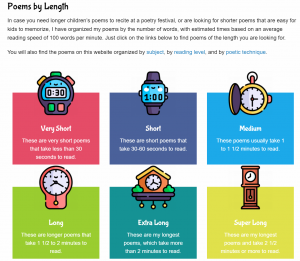
Occasionally, I get an email from someone who needs longer poems or shorter poems. They may be looking for something two or three minutes long to recite in a poetry festival. Or they may want poems that are easy to memorize.
And sometimes I get requests from teachers for poems that provide examples of a given poetic technique. It might be alliteration, metaphor, repetition, or some other device.
With more than 700 poems on this website, it will take a while to assign categories and lengths to all of my poems. So don’t be surprised if your favorite poem of mine isn’t yet in the place it belongs. I have organized about 200 poems so far, and will be working on the rest over the coming weeks.
Nevertheless, I hope you find these new features helpful. I hope you not only enjoy reading my poems, but also sharing them with your friends and family. If you are a teacher, feel free to share them with your students and use them to teach poetry in your classroom.
I often feel that summer is the best of all seasons, especially when you’re in school for the rest of the year. In the summertime, you don’t usually have to go to school. Instead you can swim, play in the park, or even just stay home and play games instead of doing homework.
I have written several poems about how much I like summer, including this one from my book When the Teacher Isn’t Looking.
I can’t wait for summer, when school days are done,
to spend the days playing outside in the sun.
I won’t have to study. No homework, no tests.
Just afternoons spent on adventures and quests.
Instead of mathematics and writing reports,
I’ll go to the park and play summertime sports.
Instead of assignments, report cards, and grades,
I’ll get to play baseball and watch the parades.
I’ll swing on the playground. I’ll swim in the pool
instead of just practicing lessons in school.
The second the school year is finally done
I’ll spend every minute with friends having fun.
I hardly can wait for the end of the year.
I’m counting the days until summer is here.
It’s hard to be patient. It’s hard to be cool.
It’s hard to believe it’s the first day of school.
In this lesson, I’ll show you an easy way to write an “onomatopoeia poem,” or what I like to call an “onomatopoem,” even though that isn’t a real word. And I’ll show you why you want to include onomatopoeia in your poems.
An onomatopoeia (pronounced on-uh-mah-tuh-pee-uh) is a word that sounds like the action it describes. For example, the word “boom” sounds like an explosion, and the word “moo” sounds like the noise a cow makes.
Using onomatopoeia in a poem can engage the reader’s senses with more vivid imagery and heightened sensory impact, without having to use additional words. If your poem contains actions, it’s a good idea to include onomatopoeia in your writing. Let me give you an example. Let’s say you were writing a poem about skiing and you said:
Skiing down the snowy hill
This describes what you are doing, and the reader can certainly visualize it. But what if, instead, you said:
Swooshing down the snowy hill
Do you see how this evokes the sense of sound? If gives the reader not just a visual image of the skier, but also the sound that their skis make on the snow, and perhaps even the side-to-side motion of the skis, all without adding extra words.
Poetry Is Condensed Language
Poetry is often described as “condensed language,” meaning that it tries to convey as much meaning and feeling as possible with few words. If you are writing prose—stories, essays, etc.—you still want to be concise; to avoid using unnecessary words. But it’s also okay to be as descriptive as possible.
In poetry, on the other hand, the more meaning or emotion you can pack into just a few words, the better. With onomatopoeia your words can do double duty, conveying both meaning and sensation. Take a look at this excerpt from my poem “What to Do with a Dinosaur” from my book Revenge of the Lunch Ladies.
This morning a dinosaur tromped into school,
ferocious, atrocious, and dripping with drool.
He had to be practically twenty feet tall,
and banged around looking something to maul.
He stomped and he snorted, he bellowed and roared.
His head hit the ceiling and busted a board.
That beast was undoubtedly ready for lunch.
He snatched up a chair in his teeth with a crunch,
I’ve underlined the onomatopoeia words in these two stanzas to make them easier to spot. As you can see, these words not only describe what the dinosaur is doing, but they evoke the sounds he is making as well. Without the onomatopoeia, it would lose a lot of its impact, as you can see below.
This morning a dinosaur came into school,
ferocious, atrocious, and covered with drool.
He had to be practically twenty feet tall,
and walked around looking something to maul.
In other words, as you write, and as you edit and revise your poems, look for opportunities to replace your verbs with ones that also evoke sounds.
An Easy Onomatopoeia Poem
If you are writing rhyming poetry, sometimes you may even want to rhyme some of your onomatopoeia words. To make this as easy as possible, I have created a list of rhyming onomatopoeia words, such as bash / crash / smash, and growl / howl / yowl.
You could even write an entire poem with almost nothing but onomatopoeia words if you like. Just look at the list of rhyming onomatopoeia words and string a few together, like this:
You can write as many lines as you want like this. Then all you need is an ending. Here are a couple of ideas:
These are sounds I heard at home.
My house sounds just like a poem.
Or how about this one?
This is not some great idea.
It’s just onomatopoeia.
Now it’s your turn. If you can add a few more lines of onomatopoeia words to this, and maybe even come up with a different ending, you’ll have created your very own “onomatopoem.”
Learning More about Onomatopoeia in Poetry
If you want to learn even more about onomatopoeia in poems, here are some useful lessons:
Kenn Nesbitt, former U.S. Children's Poet Laureate, is celebrated for blending humor and heart in his poetry for children. Known for books such as "My Cat Knows Karate" and "Revenge of the Lunch Ladies," he captivates young readers globally.
To provide the best experiences, we use technologies like cookies to store and/or access device information. Consenting to these technologies will allow us to process data such as browsing behavior or unique IDs on this site. Not consenting or withdrawing consent, may adversely affect certain features and functions.
Functional
Always active
The technical storage or access is strictly necessary for the legitimate purpose of enabling the use of a specific service explicitly requested by the subscriber or user, or for the sole purpose of carrying out the transmission of a communication over an electronic communications network.
Preferences
The technical storage or access is necessary for the legitimate purpose of storing preferences that are not requested by the subscriber or user.
Statistics
The technical storage or access that is used exclusively for statistical purposes.The technical storage or access that is used exclusively for anonymous statistical purposes. Without a subpoena, voluntary compliance on the part of your Internet Service Provider, or additional records from a third party, information stored or retrieved for this purpose alone cannot usually be used to identify you.
Marketing
The technical storage or access is required to create user profiles to send advertising, or to track the user on a website or across several websites for similar marketing purposes.