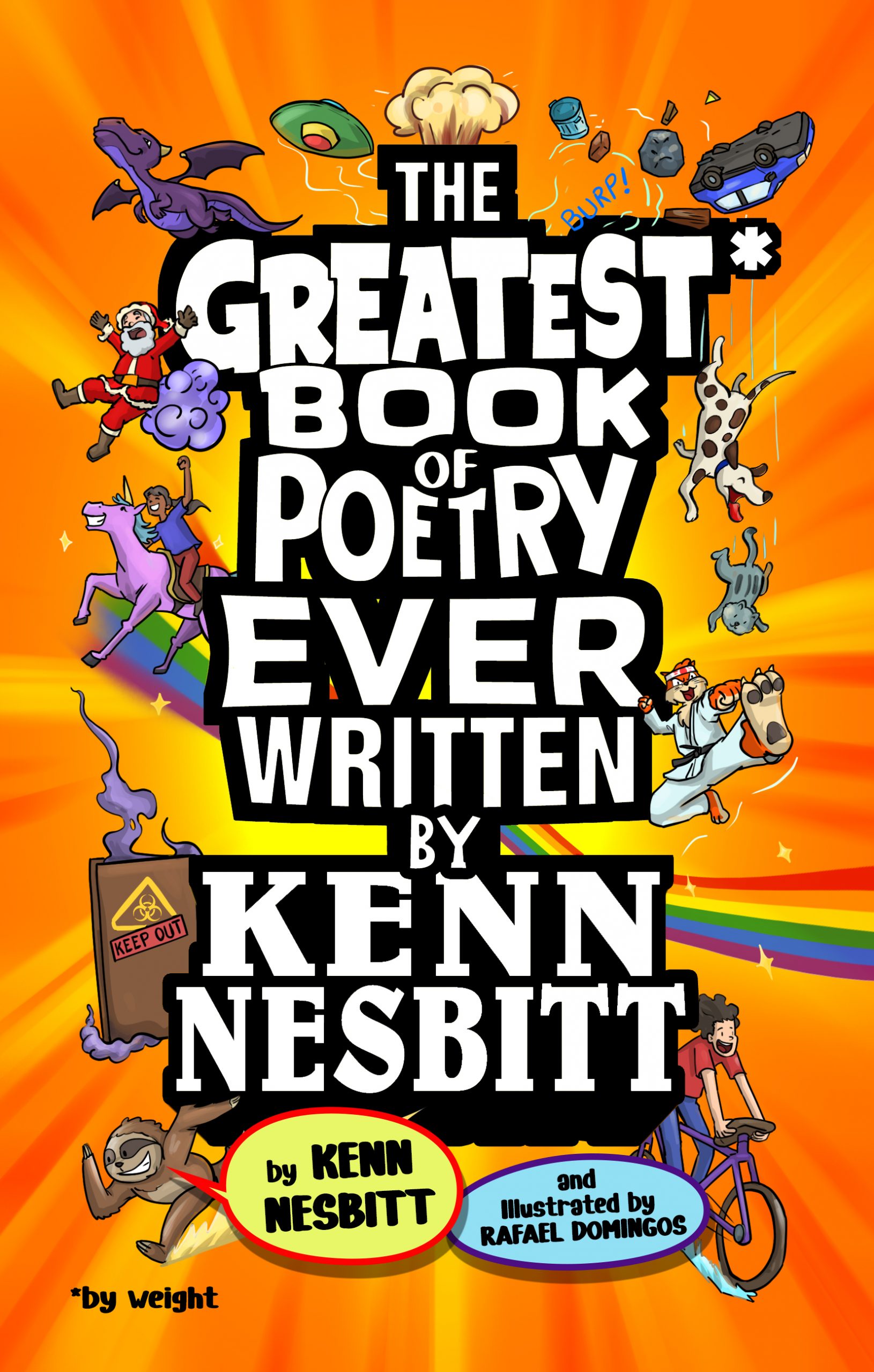
Kenn Nesbitt, former U.S. Children's Poet Laureate, is celebrated for blending humor and heart in his poetry for children. Known for books such as "My Cat Knows Karate" and "Revenge of the Lunch Ladies," he captivates young readers globally.
Welcome to Poetry4kids. I’m Kenn Nesbitt. I grew up in a part of California where it never snowed, but every now and then my parents would take me and my brothers to the nearby mountains in the wintertime to play in the snow. We loved building snowmen and throwing snowballs at one another. Later, when I moved up north where it snows every winter, my own kids grew up doing the same—building snow forts and having snowball fights, but they got to do it in the front yard.
This poem was inspired by those memories and the idea of what might happen if kids got a little carried away and missed their intended target. Sometimes, snowball fights can lead to some pretty funny and unexpected situations!
My Brother Made a Snowball
My brother made a snowball.
He threw it at our sister.
He threw it hard. He threw it fast.
His aim was bad. It missed her.
It hit our mother in the head.
It blew up like a bomb.
His eyes went wide, and then he tried
to run away from Mom.
Our mother made some snowballs, and
she threw them at my brother.
She struck him with a hundred snowballs,
one after another.
So now my brother looks just like
a snowman in our yard.
I’m pretty sure I’ve never seen
my sister laugh so hard.
Summary: This activity involves a performance where Santa Claus is found feeling unwell, and a doctor diagnoses his unusual ailment.
Presentation Suggestions: Encourage students to perform the poem in front of the class. Each student takes on a role, and they should act out their parts while delivering their lines. Santa, who has a non-speaking role, will act out feeling sick.
Props:
Santa hat and beard for the student playing Santa.
A doctor’s coat and stethoscope for the student playing the Doctor.
A pretend phone for the student playing Daddy.
Optional: A small Christmas tree to indicate the source of Santa’s allergic reaction.
Delivery: The lines of the poem should be read expressively, with appropriate emotions. Daddy should sound concerned, the Doctor should appear professional and decisive, and Santa should convincingly act out being unwell. This will help bring the poem to life and engage the audience. For tips on reciting poetry, please read this post about How to Recite a Poem Like an Expert.
Characters and Their Roles:
Narrator: Provides the main narrative and sets the scene.
Daddy: Describes Santa’s symptoms and calls for the doctor.
Doctor: Diagnoses Santa and explains his condition.
Santa: Acts sick throughout the play without speaking.
Santa’s Feeling Sick
Santa:
(Acts sick in a chair, visibly shivering, reacting to the conversation silently)
Narrator:
Daddy called the doctor,
and told him,
Daddy:
“Please come quick.
Santa’s in the living room
and feeling somewhat sick.
“Santa’s slightly out of sorts.
He’s looking rather ill,
showing certain symptoms
like a fever and a chill.
“Sad to say, he’s shivering
as if he has the flu.
Please come look. I’m sure you’ll know
exactly what to do.”
Doctor:
(Arrives and examines Santa)
Narrator:
Twenty minutes later,
when the doctor bustled in,
Santa got examined
from his elbow to his chin.
Doctor:
“Santa…”
Narrator:
said the doctor,
Doctor:
“It’s as clear as it can be…
You’ve got tinselitis;
you’re allergic to their tree!”
Ending:
End with the children reacting to the funny diagnosis, perhaps with laughter or mock surprise, to emphasize the playful nature of the poem.
Permission is given for individual school classes to perform this play and to make as many copies of the play as are needed for the students’ use. You can find my general permissions for teachers here and my general permissions for students here. For use of this play outside individual classes, please contact me for permission.
Kenn Nesbitt, former U.S. Children's Poet Laureate, is celebrated for blending humor and heart in his poetry for children. Known for books such as "My Cat Knows Karate" and "Revenge of the Lunch Ladies," he captivates young readers globally.
With Thanksgiving just around the corner here in the US, I wanted to write a fun poem about the holiday that captures the feeling of overindulging at a big family feast.
Thanksgiving is a time for gratitude and togetherness, but it’s also a time when we often eat more than we should—something kids and grown-ups alike can relate to. I thought it would be fun to explore that universal experience from a playful perspective, imagining what it might feel like to share the aftermath of a big meal with an unexpected companion.
I hope this poem brings a smile to your face as you prepare for your own holiday celebrations!
It’s Thanksgiving Night
It’s Thanksgiving night, and
I’m curled up in bed.
I’m clutching my teddy bear
next to my head.
My stomach is aching.
I let out a groan.
Then, suddenly, I hear
my teddy bear moan.
I ate too much food, so
my tummy’s in pain.
But this is the first time
I’ve heard him complain.
We’re hugging each other
and sharing our sorrow.
We can’t wait until we
feel better tomorrow.
Tonight, though, we’re whining
and huffing and puffing.
It’s Thanksgiving night, and
we’re both full of stuffing.
It’s an exciting time at Poetry4kids.com! I’m thrilled to announce that the website now features more than 1,000 funny poems for children. That’s right—over 1,000 giggle-worthy, grin-inducing, laugh-out-loud poems, all in one place, ready for you to enjoy.
Whether you’re looking for the newest poems I’ve written, the funniest fan favorites, or something a little more specific, there’s so much to explore!
Welcome to Poetry4kids. I’m Kenn Nesbitt. A couple of years ago my friend, the children’s poet Janet Wong, asked if I would contribute a poem to an anthology she was creating with children’s literature professor Sylvia Vardell called Things We Feel. She gave me several photos to choose from as inspiration, and I particularly liked one of a young boy tossing a bowling ball. It made me think about that moment of suspense—the thrill, the hope, and the uncertainty you feel as soon as the ball leaves your hands.
I make a wish.
I close my eyes.
I toss my ball.
Away it flies.
I don’t know what
my ball will do.
I pray it travels
straight and true.
But, though I hope
with all my might,
I know it could
roll left or right.
It might become
a gutter ball,
or strike the pins
and dash them all.
I hold my breath.
I feel a thrill
like time is stopped
and standing still,
and anything
is possible
the moment that
you toss a ball.
Welcome to Poetry4kids. I’m Kenn Nesbitt. As a student, I remember being so tired in school some days that I would fall asleep at my desk and the teacher would have to wake me up. I was never so tired in the morning that I went to school in my pajamas or bedsheet or blankets. But a friend of mine actually did this once when she was in college. She was so sleepy that she woke up at the very last minute, wrapped her sheet around herself and walked to class.
Recalling this recently, I thought it might be funny to write a poem about it. I hope you enjoy it.
Ideas for poems can come from lots of different places. Sometimes when I write a poem, the idea starts with a single word or a phrase. In this case, I was thinking about the upcoming holidays, Halloween and Thanksgiving. Halloween made me think of monsters, including Frankenstein’s monster, which made me think of “Frankenstein’s Thanksgiving.” It occurred to me that it might be fun to write a single poem that combines Halloween and Thanksgiving into a single holiday. This poem is the result.
The Monsters’ Thanksgiving
When monsters spend Thanksgiving
at the house of Frankenstein,
the feast is full of frankenfoods.
That’s how they like to dine.
They each will bring a favorite dish
and share it with the group.
The Blob provides the Jell-o and
the Fly supplies the soup.
The Creature from the Black Lagoon
makes slimy stewed tomatoes.
The Wolfman and Godzilla share
their monster mash potatoes.
The Zombie drops some finger foods.
The Thing makes lots of things.
The Phantom of the Opera serves
some stuffing as he sings.
The Mummy brings a bubbling bowl
of gravy from his grave.
And Dracula doles out dessert…
blood pudding from his cave.
They do this each November, and
do not invite the living.
They simply dine with Frankenstein
to celebrate Franksgiving.
Welcome to Poetry4kids. I’m Kenn Nesbitt. With Halloween just around the corner, I wanted to write a poem about the holiday. I had already written a poem about spooky monsters called “The Monsters’ Thanksgiving,” so this time I thought it would be fun to come up with a poem about trick-or-treating. I imagined creating a time-saving device to help collect more candy, and the idea of an army of trick-or-treating robots came to me.
The very next day, I saw a headline that read, “Inventor Builds Six Robot Copies of Himself, Uses One to Give Speeches and Take Questions From Audience.” I took that as a sign that my idea was timely—and that this was definitely a poem I needed to write! I hope you enjoy it.
Robot Halloween
I built a hundred robots, and
I thought it would be neat
to send them out on Halloween
and have them trick-or-treat.
They went in all directions
as they sped from door to door,
collecting treats at every house,
then moving on for more.
My robots were efficient.
They were speedy and polite.
They quickly went to every single
house in town that night.
They brought their load of candy home
and dumped it on the floor.
It filled the house so fast,
it started spraying out the door.
An avalanche of candy poured
across our porch and lawn.
Our yard was buried instantly.
Our plants and fence were gone.
We may no longer have a house
or yard, but it appears
our candy pile is big enough
to last for many years.
It turns out having robots
trick-or-treat is pretty handy.
Just make sure you have room to store
a hundred tons of candy.
Halloween is a special time of year full of spooky fun, trick-or-treating, and lots of tasty treats. But did you know that Halloween is also one of the best times to enjoy reading, sharing, and even writing poetry?
Halloween poems are full of ghosts, goblins, witches, and other monsters, and they can be just the right mix of fun and fright. They might give you a little shiver, but they also make you laugh out loud. Whether you like silly poems or spooky ones, Halloween poems can make your October even more exciting!
Today we’re going to jump into an exciting topic that might surprise you: how to blend poetry with physical education. That’s right, we’re going to explore how verses and movement can work together to create a dynamic learning experience for elementary students. So, put on your sneakers and grab your favorite poem – it’s time to get physical with poetry!
To provide the best experiences, we use technologies like cookies to store and/or access device information. Consenting to these technologies will allow us to process data such as browsing behavior or unique IDs on this site. Not consenting or withdrawing consent, may adversely affect certain features and functions.
Functional
Always active
The technical storage or access is strictly necessary for the legitimate purpose of enabling the use of a specific service explicitly requested by the subscriber or user, or for the sole purpose of carrying out the transmission of a communication over an electronic communications network.
Preferences
The technical storage or access is necessary for the legitimate purpose of storing preferences that are not requested by the subscriber or user.
Statistics
The technical storage or access that is used exclusively for statistical purposes.The technical storage or access that is used exclusively for anonymous statistical purposes. Without a subpoena, voluntary compliance on the part of your Internet Service Provider, or additional records from a third party, information stored or retrieved for this purpose alone cannot usually be used to identify you.
Marketing
The technical storage or access is required to create user profiles to send advertising, or to track the user on a website or across several websites for similar marketing purposes.
We use technologies like cookies to store and/or access device information. We do this to improve browsing experience and to show (non-) personalized ads. Consenting to these technologies will allow us to process data such as browsing behavior or unique IDs on this site. Not consenting or withdrawing consent, may adversely affect certain features and functions.
Functional
Always active
The technical storage or access is strictly necessary for the legitimate purpose of enabling the use of a specific service explicitly requested by the subscriber or user, or for the sole purpose of carrying out the transmission of a communication over an electronic communications network.
Preferences
The technical storage or access is necessary for the legitimate purpose of storing preferences that are not requested by the subscriber or user.
Statistics
The technical storage or access that is used exclusively for statistical purposes.The technical storage or access that is used exclusively for anonymous statistical purposes. Without a subpoena, voluntary compliance on the part of your Internet Service Provider, or additional records from a third party, information stored or retrieved for this purpose alone cannot usually be used to identify you.
Marketing
The technical storage or access is required to create user profiles to send advertising, or to track the user on a website or across several websites for similar marketing purposes.

 My Brother Made a Snowball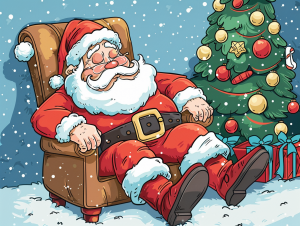

 It’s Thanksgiving Night
 Suspense
 This Morning at School
 The Monsters’ Thanksgiving
 Robot Halloween