Author: Kenn Nesbitt

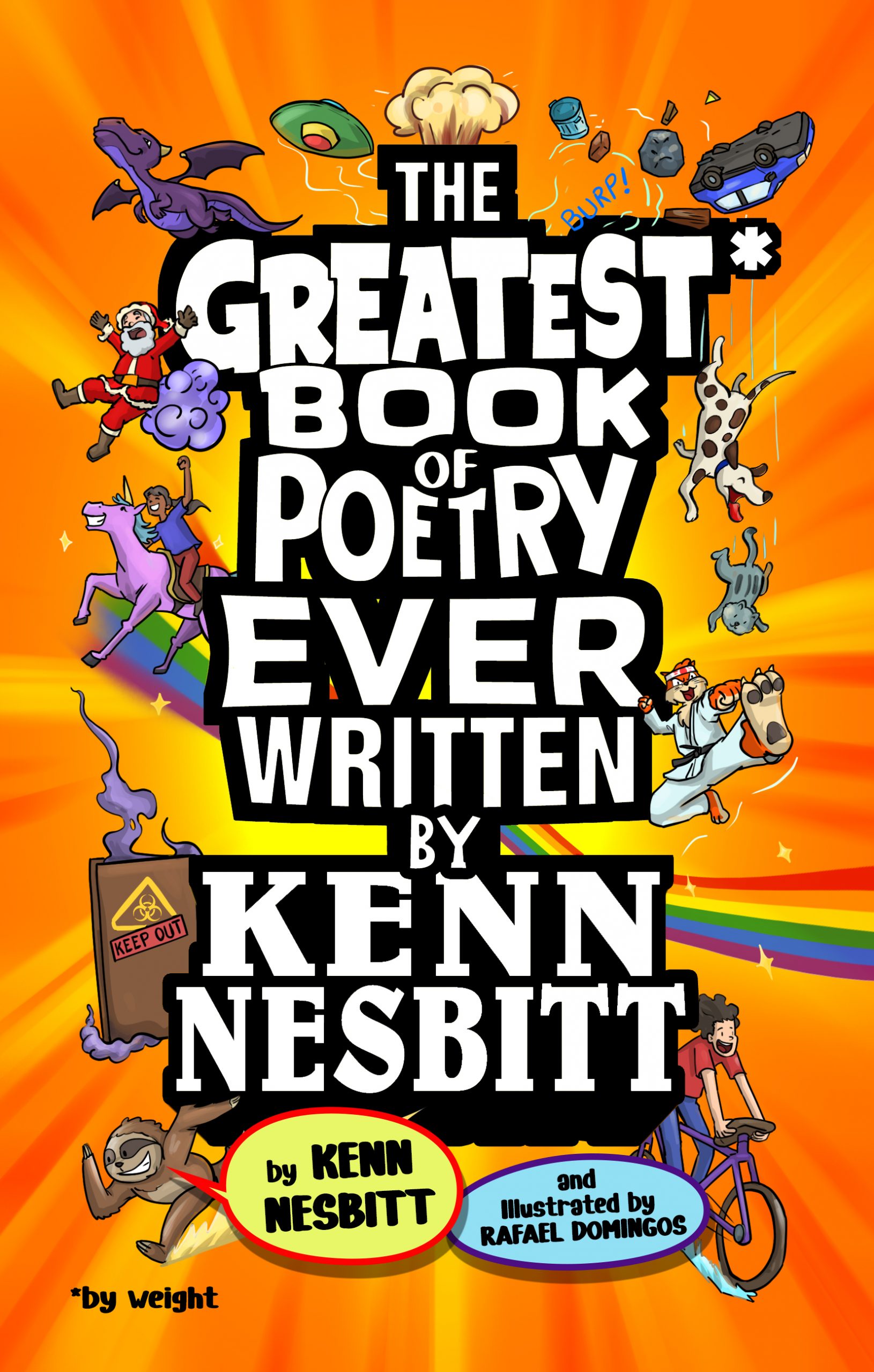
Kenn Nesbitt, former U.S. Children's Poet Laureate, is celebrated for blending humor and heart in his poetry for children. Known for books such as "My Cat Knows Karate" and "Revenge of the Lunch Ladies," he captivates young readers globally.

How to Write an Exaggeration Poem

Exaggeration means claiming something is greater than it really is. For example, if you said “my cat is as big as a house” or “I can run faster than the speed of light,” you would be exaggerating.

Exaggerating is a fun way to write imaginative poetry. When I exaggerate in a poem, I like to pick one characteristic of the thing I am writing about, and exaggerate it as wildly as I can. For example, my poem “The Biggest Burp Ever” is about a burp that is so huge it knocks over buildings, makes rivers run backward, and even widens the Grand Canyon. The crazier your exaggerations, the more exciting the poem is.

Let me give you an example, let’s say you want to write a poem about food. The first thing you need to do is pick a type of food to write about. You might decide to write about something delicious or something disgusting. You might decide to write about a cold food, a sticky food, a spicy food, etc. Let’s pick one and see what we can come up with.

Let’s say we want to write a poem about a spicy food. But let’s exaggerate and make it the world’s spiciest food. What kind of food might that be? How about the world’s hottest hot pepper? What kinds of things would happen if you ate the world’s hottest hot pepper? Would you breathe flames? Would your hair ignite? Would you drink a lot of water? Perhaps an entire lake? What else would happen? Let’s start writing and find out.

I Ate a Spicy Pepper

I ate a spicy pepper
From my brother on a dare.
The pepper caught my head on fire
And burned off all my hair.

My mouth erupted lava
And my tongue began to melt.
My ears were shooting jets of steam.
At least that’s how they felt.

I ricocheted around the room.
I ran across the ceiling.
I dove right in the freezer
To relieve the burning feeling.

I drank a thousand soda pops
And chewed a ton of ice
To try to stop the scorching
Of that spicy pepper’s spice.

At last, the flames extinguished,
I admitted to my brother,
“That pepper was the best one yet.
May I please have another?”

Let’s pick another topic. Let’s say you want to write a poem about a computer. We could make it a slow computer or a fast computer. A large computer or a small computer, and so on. Why don’t we make it not just a fast computer, but the fastest, biggest, smartest computer in the world. How big would it be? How much memory would it have? What sorts of things would it be able to do? Here’s what I came up with.

New Computer

We have bought a new computer
that’s the fastest ever seen.
It has terabytes of mem’ry
and a forty-eight inch screen.

It has all the latest gizmos
and accessories galore.
It has every last peripheral
they carried at the store.

It has disk drives by the dozen
it has twenty-seven mice,
and it even has a microwave
included in the price.

It can teach you how to mambo.
It can play the violin.
It can calculate the distance
from Botswana to Berlin.

It can speak in seven languages
with scholarly finesse,
then defeat the world’s grandmasters
in a tournament of chess.

It can conjure anti-gravity,
or build a time machine.
Our computer is undoubtedly
the fastest ever seen.

When we went and bought it yesterday
we thought it pretty neat,
but today our new computer
is already obsolete.

So you see, to write your own exaggeration poem, you only need to do three things:

  1. Pick something to write about.
  2. Pick a feature or characteristic of the thing that you are writing about.
  3. Exaggerate that characteristic in every way you can think of, making a list as you go.
  4. Take your list of ideas and turn them into a poem.

Here are some more tips to help you get started:

  • When you write your exaggeration poem, it doesn’t have to rhyme, unless you want I to.
  • If you can’t think of a funny ending for your poem, try ending it with the same lines you used at the beginning of the poem.
  • If you have trouble thinking of something to write about, read Chapter 3 of How to Write Funny Poetry on this website for some ideas.

Good luck writing your own exaggeration poems!

Kenn Nesbitt
Follow Kenn

How to Write a Clerihew

You’re going to love learning how to write clerihews. Why? Because clerihews are funny poems you write about specific people. That means when you learn to write a clerihew, you can instantly write funny poems about your parents, your teacher, your favorite movie star, your best friend, your pet, or anyone else you can think of. The clerihew was created by a poet named Edmund Clerihew Bentley (and named after himself!) when he was just 16 years old, proving you don’t have to be old to invent a new kind of poem.

Clerihews have just a few simple rules:

  1. They are four lines long.
  2. The first and second lines rhyme with each other, and the third and fourth lines rhyme with each other.
  3. The first line names a person, and the second line ends with something that rhymes with the name of the person.
  4. A clerihew should be funny.

That’s it! You don’t have to worry about counting syllables or words, and you don’t even have to worry about the rhythm of the poem.

Let’s look at an example. Let’s say your art teacher was named Mr. Shaw, and you wanted to write a clerihew about him. You might start your clerihew like this:

Our art teacher, Mr. Shaw,
Really knows how to draw.

Notice that the first line ends with the name of the person the clerihew is about, Mr. Shaw. The second line ends with “draw” because it rhymes with “Shaw.”

To finish the clerihew, you need to write two more rhyming lines. In a well-written clerihew, those next two lines will make the poem funny, like this:

Our art teacher, Mr. Shaw,
Really knows how to draw.
But his awful paintings
Have caused many faintings.

You don’t have to limit yourself to writing clerihews about people you know. You can write clerihews about people you have never met. A clerihew will work best, though, if you write it about someone who is well known, or who at least is known to the people who will read it.

For example, if I wrote a clerihew about my aunt Norma, that might not mean anything to you. But it might work very well if I planned to share it only with my family. On the other hand, if I wrote a clerihew about a famous musician, it might be funny to many more people. Here is an example of a clerihew about some well-known singers:

The music of Katy Perry
Is kind of scary.
I heard it and sniffed,
“I much prefer Taylor Swift.”

And you don’t have to limit your clerihews to real people. You can even write clerihews about characters from books, movies, comics, cartoons, etc. Here’s an example of a clerihew about a character from a book:

The enemy of Harry Potter
Was a scheming plotter.
I can’t tell you what he’s called; I’d be ashamed
To name “he who must not be named.”

So you see, clerihews are short, easy to write and can be about any person or character, real or not. They can be about people you know, people you don’t know, or even about animals, cartoon characters, rock groups, or anyone else you can think of.

Just remember, put the person’s name at the end of the first line, rhyme it at the end of the second line, and then write two more rhyming lines that make it funny, and you’re done. Have fun!

Clerihew writing worksheet for kids

Click here to download a clerihew writing worksheet

Kenn Nesbitt
Follow Kenn

New Construction at Poetry4kids.com

Poetry4kids.com is currently undergoing a little bit of new construction. For now the changes will only affect a few pages on the website, such as the News and Videos, so you shouldn’t notice anything at all. But, if you do come across anything quirky, rest assured that I’m working to get everything squared away as quickly as possible.

The reason I am upgrading the website is that these new changes will make it easier for me to maintain poetry4kids.com so I can spend more time creating new poems, videos, lessons, and other resources for you to enjoy.

If you happen to notice any broken links or anything that doesn’t appear to be working right, please feel free to drop me a line so I can be sure it gets fixed right away.

My Brother’s Not a Werewolf

Podcast

Subscribe to this Podcast

My brother’s not a werewolf
though it often looks that way.
He has to shave his whiskers
almost every single day.

His feet are getting furry
and his hands are sprouting hair.
His voice is deep and growling
like a grumpy grizzly bear.

He often sleeps throughout the day
and stays up half the night.
And if you saw the way he eats
you’d surely scream in fright.

His clothes are ripped and dirty
like the stuff a werewolf wears.
His socks and shirts are shredded
and his pants have countless tears.

If you should ever meet him
you’ll discover what I mean.
My brother’s not a werewolf;
he’s just turning seventeen.

— Kenn Nesbitt

Copyright © 2011 Kenn Nesbitt. All Rights Reserved.
www.poetry4kids.com

Thrills, Chills, and Laughs in the Classroom

Trick or Treat

Of all the holidays that we celebrate each year, Halloween is the one with the greatest potential for sparking the imagination. Kids (and let’s be honest, quite a few adults, too) are thinking about the costume they’ll wear, long before the actual night. And it’s easy to get everyone excited about making fun decorations for the classroom and elsewhere.

Witches, goblins, superheroes, and cartoon characters meet Jack o’Lanterns, fangs, and zombies in a festival of the unreal and the fantastic. (Not to mention all the free candy!) It’s the perfect opportunity to round up some of that bubbling excitement, and turn it into poetic fun! Here are a few ideas for the Scary Season, activities that are easily adaptable for most age-groups.

How to Rhyme

A video poetry-writing lesson

The first in a series of videos demonstrating different aspects of poetry writing for elementary students, this video shows what a rhyme is (and what is NOT a rhyme). It gives examples of different types of rhymes, and it demonstrates where to put rhyming words when writing a poem.

Interview with U.S. Children’s Poet Laureate, J. Patrick Lewis

J. Patrick Lewis

Podcast

Subscribe to this Podcast

This week I had the pleasure of speaking with J. Patrick Lewis about his career, his books, and his new position as Children’s Poet Laureate of the United States. Pat was charming as he shared stories and even read a brand new poem.

Click the play button below to listen to the interview or click here to subscribe to the Poetry4kids.com podcast for more funny poems and interviews with well-known children’s poets.


My Parents Sent Me to the Store

For quite some time I’ve wanted to create animated videos of my poems. Here is the first in what I hope will be a long series of videos, “My Parents Sent Me to the Store.”

Note: If you’d like to read along with the poem, click on the “cc” button at the bottom of the video once it starts playing.

Boney Mahoney

Podcast

Subscribe to this Podcast

I’m Boney Mahoney,
the Skeleton Singer.
I’m known for harmonious tones.
I’ll croon to the tune of
a jaw harp or hand drum.
I’ll trill to the sound of trombones.

To have me start humming
just tickle the ivories.
I’ll sing if you finger a bell.
I’ll rap if you slap at
a washboard or rattle.
I’m hip to the nose flute as well.

If you’re a musician
in search of a singer
just give me a telebone call.
But find someone else if
you only play organ;
I don’t sing with organs at all.

–Kenn Nesbitt

31 Days of Funny Spooky/Monster Poems

Beginning October 1 and continuing throughout the month, right up until Halloween, I will be posting a funny spooky poem or funny monster poem every day on Facebook, Google Plus, and Twitter. Follow me now to read them all! Click on the Facebook or Google Plus logo on the left or the Twitter logo on the right to follow.

NOTE: You don’t need an account to follow along and read the poems. Even without an account, you can still view the Twitter feed and link to the poems. Just click on the Twitter link on the right to see my tweets, which will have links to the poems.