You Can Do It
I promise you, you can write wonderful, exciting, funny poetry that will amaze your parents and teachers, and have your friends falling down laughing. Everything you need, except for a pencil and a piece of paper, is in this book right here in your hands. I know you don’t believe me yet, but keep reading and I will show you lots of simple methods you can use to create your own original, hilarious poetry. You will soon find it is simpler than you thought and people are going to wonder how you got so talented.
Getting Started
Maybe you have thought about writing poetry, but don’t know how to get started. Or maybe you are already writing poetry, but want to learn how to make it better. Whatever your reasons for picking up this book, get ready to have some fun! Just by reading a few chapters in this book, you will be able to write funny, exciting poetry. By learning a few specific tricks and techniques, you will soon be amazed at your own poetic skill. Most importantly, you will have a lot of fun doing it.
But what if you fail? What if you find can’t write poetry? Or worse, what if you write a poem and someone tells you it isn’t any good? I swear to you, cross my heart, if you can read this book, you can write poetry. In fact, you will soon find that it is nearly impossible to fail. I say “nearly” because there is really only one way you can fail when it comes to writing poetry: to not write at all. If you have written a poem, you have succeeded, even if someone else tells you they don’t like it.
Let me give you an example. If you want to be a runner, you don’t run a four-minute mile the first time you try. Even if it takes you 20 minutes to run a mile the first time you try, you will have succeeded if you complete the goal you set for yourself. If someone tells you, “you’ll never be a runner because it took you 20 minutes to run a mile,” pay no attention. Just run another mile and another. Soon you’ll be running 15-minute miles, and 10-minute miles, and 8-minute miles, and faster.
Writing poetry works the same way. Each time you do it, you get a little bit better. If someone tells you “your poem isn’t any good,” pay no attention. Each poem you write makes you a better poet. If you write a new poem every day for a month, you will be a better poet at the end of the month than you were when you started.
TIP: You become a good poet by writing lots of poems. Each time you write a new poem, try to make it as good as you can and your skill will improve with each poem you write.
The reason that you become a better poet by writing poems is because, no matter what skill you want to learn, you always “learn by doing.” After you have written your first poem, you will know something that you did not know before, even if it is just that you can write poetry. After you have written your second or third poem, you will know even more, perhaps you will have learned something about rhyming or the rhythm of poetry. By the time you have written twenty or thirty poems, you will find it both easy and enjoyable.
At each step of the way, I will be here to guide you. I will be with you on each page of this book to show you how to make people laugh and enjoy your poetry. I will give you the tools and the knowledge you need to make your poems as good as they can be. Although this book contains a fair bit of “technical” information about poetry, I have tried my best to make it as easy to understand and fun to learn as possible. I have also included plenty of helpful tips, examples, and fun exercises to help you learn to write your own original funny poems. All you need to do is open this book to any chapter and start reading.
In this first chapter, I show you how to get started writing poetry and offer some general advice for the new poet.
What “Tools” Will You Need?
As with any hobbies or sports you might enjoy, writing poetry requires a bit of special equipment. Fortunately, it does not require any protective clothing such as helmets or knee pads, and is not generally considered to be dangerous. All you really need is a pencil and a piece of paper. Though a pencil and paper are the only things required, if you are serious about writing poetry, there are a couple more things you should have.
The Importance of a Notebook
The most important tool you should have as a poet is a small notebook, preferably one that fits in your pocket, that you can carry with you everywhere you go. You never know when an idea will come to you, and if you don’t write it down, it is likely you will forget it. By carrying a notebook with you at all times, you can write down your ideas immediately when they come to you so that you don’t forget them.
Some poets prefer to use a “journal,” which is like a book with blank pages that you can write whatever you want in. A journal is sort of like a diary, except that it doesn’t have pages for each day of the year. Instead, you can organize it any way you like. Personally, I prefer a pocket notebook because it is easier to carry. But you should use whichever feels more comfortable to you.
So go get yourself a small notebook or a journal and start writing down ideas. When you write down an idea, it doesn’t have to be an entire poem. An idea can be as simple as noticing a fun rhyme and writing it down to use it later. In my notebook, I often write down single words that I think are funny or interesting, such as “linoleum” or “Bermuda” because I like the way they sound and I think they might be useful in a poem later.
Don’t worry about neatness. Be as messy as you want and don’t worry about spelling or punctuation. The only thing that matters is that you capture ideas as them come to you by saving them in your notebook or journal.
You can also use your notebook to write entire poems, or to start poems that you can finish later. Sometimes I will write down a single line that I think might make a good first line of a poem, like “The fish in our aquarium are looking rather sad” or “The pumpkin and the ladybug were drifting on the sea.” Sometimes I may write a verse that I think of that is not a complete poem, such as “I think my brain is wearing out, from working much to hard, and now it’s just as useful as a bucketful of lard” or “Molly McDoon was a purple balloon, who floated all morning and all afternoon.” Someday I may take these “starters” and write entire poems from them.
TIP: A notebook you can carry with you all the time is your most important tool for writing poetry. Take it with you everywhere you go, and always try to remember to write your ideas down when they come to you.
Other “Tools of the Trade”
The serious (or not-so-serious) poet has several other tools in his or her arsenal in addition to pencil and paper. These include a rhyming dictionary, a standard dictionary and a thesaurus.
TIP: The only tools you really need to write poems are a pencil and paper, and your brain. But writing poetry can be even easier if you have a rhyming dictionary, a dictionary and a thesaurus.
Rhyming Dictionary
The most important of these is probably the rhyming dictionary. If you have never seen a rhyming dictionary, it is a book that lists the words that rhyme with end sounds of other words. For example, if you want to find a rhyme for “cat,” you would look up “at” in a rhyming dictionary, because “at” is the ending sound of the word “cat.” The rhyming dictionary would give you a list of words, including “at,” “bat,” “cat”, “fat,” and so on.
My personal favorite paperback rhyming dictionary is the Complete Rhyming Dictionary by Clement Wood. If you do not already own a rhyming dictionary, I recommend you consider adding a copy of this book to your library.
Although paperback rhyming dictionaries are handy when you are away from a computer, rhyming dictionary software is easier to use and far more useful. My favorite rhyming dictionary software is called Rhymesaurus, and you’ll find it here:
In addition, there are several online rhyming dictionaries. Here are a couple of the best:
Dictionary
In addition to a rhyming dictionary, you should also have a regular dictionary and a thesaurus. If you do not already have a dictionary, my personal favorite dictionary is the hardback “college edition” of Webster’s New World Dictionary, published by Simon and Schuster.
In my opinion, dictionaries are not all created equal. Some dictionaries are better than others in terms of word selection, clarity of definitions, and so on. If you don’t believe me, or if you just want to prove it to yourself, go to the library and get several dictionaries from the reference section. Now look up the same word in each dictionary and see how the definitions are organized and written. You may find you have a favorite as well. If this seems like too much trouble to you, just take my advice and get yourself a copy of the Webster’s New World Dictionary. Make sure it’s the hardback “college edition” and not the paperback version, which is a smaller, more concise edition.
Just as there are rhyming dictionaries on the Internet, there are also several standard dictionaries on the Internet. The easiest one to remember is “dictionary.com” at https://www.dictionary.com. However, I usually use Merriam-Webster’s online dictionary at https://www.m-w.com, as it is a more modern and more complete dictionary.
Thesaurus
Finally, the last tool that every poet should have in his or her toolbox is a good thesaurus. A thesaurus is a “dictionary of synonyms and antonyms”, allowing you to easily find words that “mean the same thing” or the opposite of a given word. Often I use a thesaurus to help me find words to use in my poems. For example, in the following poem, I looked up the word “detective” in my thesaurus and came up with several synonyms, including “private eye”, “spy”, “Pinkerton”, “gumshoe” and “sleuth”.
My Dad’s a Secret Agent
My dad’s a secret agent.
He’s an undercover spy.
He’s the world’s best detective.
He’s the perfect private eye.
He’s a Pinkerton, a gumshoe,
he’s a snoop and he’s a sleuth.
He’s unrivaled at detecting
and uncovering the truth.
He’s got eyesight like an eagle.
He’s got hearing like a bat.
He can out-smell any bloodhound.
He’s as stealthy as a cat.
He can locate nearly anything
with elementary ease.
But no matter how he looks and looks
my dad can’t find his keys!
Using a thesaurus can help you improve your poems by choosing more appropriate words, or words that fit the structure of your poem better. They can also help by giving you new ideas that you wouldn’t think of otherwise. I often find my poems take on a new direction after I spend a little time “surfing” a thesaurus. As with the dictionary and rhyming dictionary, you can also find thesauri (the plural of thesaurus is thesauri) on the Internet. The easiest one to remember, and possibly the best one on the Internet, is Roget’s International Thesaurus at https://www.thesaurus.com. Merriam-Webster also has a thesaurus at https://www.m-w.com, but I prefer thesaurus.com.
TIP: If you have a computer and Internet access, you don’t need to buy reference books such as a rhyming dictionary. All the references you need are available online!
Start Right Now!
People often ask me what I think is the hardest part of writing poetry. They usually think it is the rhyming, or the meter, or coming up with a clever idea, or some other technical aspect of poetry. However, in my opinion, the hardest part of writing poetry is not any of these things. Instead, I think the hardest part of writing poetry is sitting down and starting. I once heard Michael Crichton, the best-selling author, refer to this as “putting butt to chair”.
It is so much easier to go see what’s in the refrigerator, or find out what’s on TV, or play a game, or clean your room, or do your homework, or do just about anything besides sit down and write. But despite this fact, you will often find that, once you actually do sit down to write, that the writing is not has hard or as painful as you thought it might be.
Remember what I said earlier in the chapter: the only way you can fail at writing poetry is to not write at all. So remember every now and then to stop whatever you are doing and sit down and write. If you do this often enough, you will soon have a lot of poems and you will be a much better poet than you are today.
Wait Until You Are Done Writing to Edit
A very important job that all poets and other writers must learn is the job of re-writing, or “editing.” Editing is the task of making changes to your writing to improve it. Poems are almost never done when you first think they are done. I often “finish” a poem, only to find the next day that it can be improved by changing a word or a line, or even by removing a whole verse.
The trouble with editing is that you often want to do it while you are writing your first draft. It is tempting to spend time correcting spelling, searching for the perfect word, and so on. Unfortunately, if you stop to make corrections as you write, trying to make each line perfect as you write it, you will find it much harder to finish anything.
TIP: Editing while you write can slow you down. If you can’t find the right word or the perfect sentence, move on to the next verse and come back to the problem later when you will see it with “new eyes.”
On the other hand, if you force yourself to keep writing, even if something is not perfect; if you push yourself to move on rather than letting yourself get stuck, you will get a lot more written. Oftentimes a problem that seems insurmountable will be quite simple to fix when you look at it later. Some people have referred to this as seeing it “with new eyes.” By this, they mean that you have a fresh perspective on it when you’ve been away from it for a while.
If you watch a sculptor carve a statue from a block of stone or wood, you will see that they first carve out the rough form. Next, they come back and carve the detail. Finally, they come back and polish it.
When you write poetry, think of yourself as a sculptor of words. Don’t try to polish it before you finish the detail, and don’t try to finish the detail until you have carved out the rough form.
Save Your “Unfinished” Work
If you have trouble finishing a poem, don’t worry about it. Do your best, but if you run into difficulty, it may be best to set it aside and look at it later when you are fresh.
Many times I will write most of a poem, but leave a section of it, maybe just a line or two, unfinished because I run into a problem that I don’t know how to fix. I keep these unfinished poems because I know that I will usually be able to finish them later.
Sometimes, if I can’t think of the right word to put in a line, I will just write the words “blah blah.” Then, when I come back to edit the poem later, I’ll see those words and know that I have to replace them with a real word. Writing “blah blah,” when I can’t think of the right word to use, frees me up to keep going and work on the rest of the poem.
Don’t Worry About Spelling and Punctuation
Spelling and punctuation (commas, periods, semicolons, etc.) are important, but you should try not to worry about them as you are writing. Spelling and punctuation are part of the “polishing” stage of writing a poem. They aren’t really important until you are all done writing your poem.
After you feel you are completely done with your poem, that is the time to go back over it to check your spelling and punctuation, but you should not let spelling and punctuation slow you down as you write.
TIP: Don’t worry about spelling or punctuation until you are done writing a poem. Check the spelling and punctuation as part of a final “polishing,”
If you have a computer with a word processor, try typing your poem in and letting the computer check your spelling for you.
In Chapter 8, I discuss how to use punctuation in a poem to help you polish your poems. But until you feel you are ready to put these types of “finishing touches” on your poems, don’t even worry about it.
Don’t Criticize Yourself
Earlier in this chapter, I told you not to listen to people who criticize your poems. Now I am going to tell you something even more important: don’t criticize yourself.
If you tell yourself that your poetry is not any good, you will probably stop writing before you ever have a chance to improve. Remember, each poem you write is part of your journey to becoming a good poet.
TIP: Don’t criticize yourself or your poetry. Instead, congratulate yourself each time you complete a new poem!
Some of your poems will be better than others. Nobody can write all good poems. It is a fact of life that no one can write good poems without writing a few bad ones too. I should know; I have written my share of “stinkers.” So if you write a poem that you think is not very good, don’t let it worry you; just put it away and go write another poem.
You Don’t Have to Know How it Ends
You may find this surprising, but you don’t have to know how a poems ends before you start writing it. Quite often poems turn out to be about something other that what you expect when you start. Writing poetry is an “organic” process. That means that each poem you write grows and takes on a life of its own as you write it.
Trying to figure out how your poem will end before you start it can slow you down, or prevent you from writing altogether. My advice is don’t worry about it. If you think you have a good idea for a poem, but don’t know how it will end, just start writing. You will figure out the ending as you write.
Let me give you an example. One day I decided to write a love poem about Valentine’s Day. It was going to be about kids exchanging valentines in class and about the embarrassment of giving a big valentine to someone you really like. However, as I was writing it I was thinking about movie monsters like Godzilla and the Wolfman, and I ended up writing the following poem:
Will You?
Will you be my Valentine?
Will you marry me in June?
Will you lock me in the basement
when there is a bright, full moon?
Will you bring me lots of roses?
Will you bring me chocolate sweets?
Once a month when I get hairy,
will you feed me doggy treats?
Will you treat me with devotion?
Will you bless me when I sneeze?
Will you dust my back with powder
just in case I’ve gotten fleas?
Will you be my darling angel?
Will you be my dream divine?
That’s exactly what the Wolfman
said to Lady Frankenstein.
As you can see, poems can change a lot as you write them. So don’t worry if you don’t know what your poem is about when you start it. You may find that you discover what the poem is about when it is halfway written, or even when it is nearly complete.
At the same time, be open to letting your poem change and grow as you write it. It’s okay to change your mind while you are writing. In fact, a lot of the time it is unavoidable because you will get lots of new ideas as you write, and some of those new ideas may be very different from the ideas you started with.
Different Types of Poetry
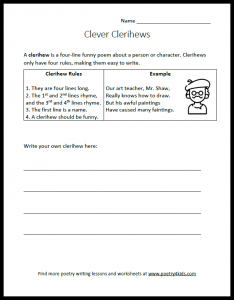
A friend of mine once said, “There are two types of people in the world; those who divide people into two types and those who don’t.” Similarly, although there are many different types of poetry, they are usually divided into just two groups: structured poetry and “free verse.” Structured poetry can follow one of the traditional poetic forms such as a “limerick” or a “clerihew,” as shown in chapters 5 and 6, or it can be a rhyming poem with or without meter. Free verse, on the other hand, usually has no rhymes and no set meter.
TIP: Don’t worry if you are unfamiliar with poetic terms such as “clerihew” or “meter,” You can look them up in the Glossary at the end of the book, or you can read more about them in later chapters.
Rhyme-and-Meter
“Rhyme-and-meter” poetry is poetry that has rhyming lines, and meter or rhythm. Usually the rhymes are at the end of each line, or every other line. “Meter” usually means that every line or every couplet (a couplet is a pair of lines) has the same rhythm; the same number of syllables and the same pattern of emphasis. I talk about meter in detail in Chapter 7, so don’t worry too much about it right now, except to realize that when I say “meter,” I mean that the poem has a rhythm to it.
Rhyming Poetry Without Meter
Just because a poem rhymes, does not necessarily mean that it has to have meter. Rhyming poetry usually has meter as well, but this is not a requirement. In general, I recommend that rhyming poetry should either have a very strict meter, or an extremely loose, exaggerated lack of meter. Take a look at the following example:
Mary had a little lamb
she fitted with a saddle.
Mary rode it every time
that she was herding cattle.
This poem has four lines. Notice that the second line and the last line rhyme, and that they have exactly the same rhythm or meter. Also, the first line and the third line have the same meter. Now look at this example of rhyme without meter.
I wanted to write a rhyming poem,
But everyone said it had to have the same number of syllables in each line and a consistent pattern of emphasis and I disagreed, so instead I wrote this one just to show ’em!
In this poem, the lack of meter is very obvious and exaggerated. The reason for this is to let the reader know that your lack of meter is intentional. If you write a rhyming poem without meter, but without making it obvious that the lack of meter is intentional, the reader may just think that you don’t know what you are doing.
Good, consistent meter in rhyme-and-meter poetry is an indication of a talented and experienced poet. When you are just getting started, don’t worry too much about meter. As you write more and more poetry, you will find that you begin to recognize meter. When you get to the chapter in this book on meter, you will learn and you can start incorporating it into your own poems.
Free Verse
Free verse is poetry that does not necessarily have rhymes or meter. In free verse, your lines can be as long as you want, they don’t have to rhyme, and they don’t have to follow any type of pattern. Here is one example of free verse.
First Horseback ride
I never rode a horse before,
until that sweltering August day
riding through
the New England woods
the horse was
swatting
flies
with
her
tail
and I was helping
trying hard to
swat
flies
with
my
hand.
That was when I discovered
how reins are not
like steering wheels,
for no matter which way
I turned or pulled
she would only go
to the barn.
As you can see, the above poem has no rhyme, no rhythmical pattern, no fixed number of lines, and so on. In short, it has no structure at all. This is what makes it “free” verse. And this is what makes it so much fun to write.
Free verse is wonderful because there are no constraints on what you can or cannot do. There are no rules to follow so you can’t possibly do anything wrong.
In free verse, you are free to tell a story, play with words, express your feelings, or do whatever you like to create something interesting and new.
Humorous Poetry
In Chapter 4, I discuss specific techniques for making a poem funny. Before we get there let me say that, in general, most funny poetry has rhyme and meter. Although there is some funny free verse, it is easier to make a poem funny if it has rhyme and meter. One reason for this is that rhyme and meter can make a poem feel more lighthearted. Take a look at the following example.
I had a love,
her name was Jill,
I met her in December.
I loved her more
than anybody
else I can remember.
Although the subject is serious, the rhyme and meter make it feel less so. The light, bouncy rhythm of this poem is in contrast to the serious subject. This makes it easy to follow this first serious verse with a second one that is less serious:
When we broke up
I then met Joan
while strolling through the dog pound.
We played a lot
of basketball
since we met “on the rebound.”
As you can see, the playful nature of rhyme-and-meter poetry makes it a natural fit for humor. A poem does not have to rhyme in order to be funny. It is just easier to make poems funny when they rhyme. It is more difficult, though not impossible, to write funny poetry in free verse. For this reason, and the fact that this book is entitled How to Write Funny Poetry, this book focuses mainly on rhyme-and-meter poetry.
Ready, Set, Go!
Here you are at the end of Chapter 1. Believe it or not, you already know a lot more about poetry than you did at the beginning of this chapter. You know what tools you need to write poetry (pencil and paper), what special books can help you (dictionary, thesaurus and rhyming dictionary), the two main types of poetry (structured poetry and free verse), and how to avoid the most common pitfalls that most poets face.
Armed with this information, you are ready to start writing. So let’s move on to Chapter 2, where you will learn how to rhyme, and you will even write a few poems of you own!
Kenn Nesbitt, former U.S. Children's Poet Laureate, is celebrated for blending humor and heart in his poetry for children. Known for books such as "My Cat Knows Karate" and "Revenge of the Lunch Ladies," he captivates young readers globally.
Latest posts by Kenn Nesbitt
(see all)