A Pathway for Pollinators
Every year, I read dozens of children’s picture books and poetry collections about nature, science, and conservation. Many are informative. Some are beautiful. A few manage to be both. But it is surprisingly rare to find one that teaches an important environmental concept while also succeeding as a genuine work of poetry.
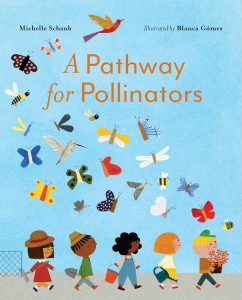
Michelle Schaub‘s A Pathway for Pollinators, illustrated by Blanca Gómez, is one of those rare books.
At its heart, this picture book explains the idea of pollinator pathways: networks of pollinator-friendly habitats that help bees, butterflies, hummingbirds, bats, and other pollinators travel safely through developed areas. It’s a timely and important subject, but Schaub never allows the book to become a lesson disguised as a story. Instead, she uses lyrical language, carefully chosen imagery, and an inviting rhythm to turn a scientific concept into something young readers can see, hear, and feel.
The book opens with a meadow alive with activity:
Flitter.
Flutter.
Buzz.
Hum.Come . . . watch a meadow thrum.
See it sing
with flowers
and wings.
In just a few short lines, Schaub establishes both the musicality of the text and the sense of wonder that runs throughout the book. You can almost hear the bees buzzing and the wings fluttering overhead. It’s a lovely example of how poetry can make information memorable.
One of the things I admire most about this book is its structure. The story begins in an open meadow where pollinators thrive, carrying pollen from flower to flower. Then the scene changes. The meadow gives way to roads, buildings, and neatly trimmed lawns. As cities grow, meadows disappear, and the question naturally arises: “Where will pollinators feed? Can we give them what they need?”
The answer, of course, is yes.
From there, the book becomes a hopeful blueprint for action. Rather than dwelling on environmental loss, Schaub focuses on solutions. Schools, neighborhoods, businesses, balconies, vacant lots, parks, and backyards all become part of a larger vision. Readers learn that even small patches of habitat can help connect pollinators to the resources they need.
I particularly appreciate the way the book emphasizes community. Pollinator pathways aren’t presented as something that only scientists or governments can create. Instead, Schaub shows children, teachers, families, and neighbors working together. The message is empowering without being preachy: everyone can help.
The poetry itself is wonderfully accessible. The language is simple enough for young readers, yet rich enough to reward repeated readings. Throughout the book, Schaub uses short lines, internal rhythms, and carefully placed repetition to create momentum. Consider this passage:
Connect
one wild place
to the next.Habitats linked
dot to dot.A chain of pollinator pit stops.
The phrase “dot to dot” beautifully captures the central idea of the book. Young readers immediately understand the image, and the concept of connecting habitats becomes tangible and easy to grasp.
The illustrations deserve special praise as well. Blanca Gómez’s artwork is bright, stylized, and full of charm. Her simple shapes and bold colors create spreads that feel both contemporary and timeless. As the story progresses, readers can literally watch the pathway grow. Small gardens appear in window boxes, on rooftops, along streets, and in schoolyards until the entire community feels connected by flowers and pollinators.
One of my favorite aspects of the artwork is how it mirrors the book’s central theme. Individual flowers, butterflies, birds, and people appear throughout the pages, gradually forming a larger network. The visual storytelling reinforces the text’s message that small actions, when combined, can have a significant impact.
Educators will find plenty to love here as well. The book naturally supports discussions about ecosystems, pollination, native plants, conservation, community action, and environmental stewardship. It could easily serve as a springboard for classroom gardening projects, pollinator studies, or poetry lessons focused on sound and imagery.
I also appreciate the extensive back matter, which provides clear explanations of pollinators, pollinator pathways, native plants, and practical ways readers can help. The information is presented in an accessible format and extends the learning without interrupting the flow of the story itself.
Perhaps what I enjoyed most about A Pathway for Pollinators is its sense of optimism. Environmental books for children sometimes lean heavily on warnings and problems. Schaub acknowledges those challenges, but her focus remains firmly on possibility. The message isn’t that the world is broken. The message is that people working together can make things better.
That’s a powerful idea for young readers.
By the final pages, the buzzing, fluttering world of the opening spread has returned, but now it extends through the entire community. Pollinators benefit. Plants benefit. People benefit too. The pathway welcomes everyone.
If you’re looking for a picture book that combines poetry, science, and environmental awareness with grace and beauty, A Pathway for Pollinators is an excellent choice. Michelle Schaub has created a book that informs, inspires, and invites readers to become part of the solution, one flower at a time.

- My Hamster Has a Hovercraft - October 19, 2026
- Weekly Children’s Poetry Roundup – Saturday, October 17, 2026 - October 17, 2026
- My New Poetry Book Is Here! - October 13, 2026