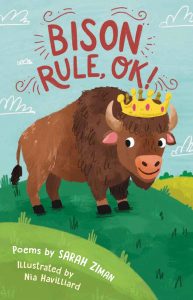
Bison Rule, OK!
Every so often, a poetry collection comes along that reminds me just how broad children’s poetry can be. Some poems make you laugh out loud. Some capture moments of family life with startling accuracy. Some tell stories. Some play with language. And some quietly sneak up on you and leave an emotional mark you weren’t expecting.
Sarah Ziman’s brand-new collection, Bison Rule, OK!, arriving this August from Otter-Barry Books, manages to do all of those things in a single volume.
From the opening pages, it’s clear that Ziman has an excellent ear for the way kids think, speak, argue, exaggerate, daydream, and make sense of the world around them. Whether she’s writing about school, family, animals, holidays, or the small dramas of everyday life, her poems feel authentic. These are poems that sound as though they belong to real children.
The collection is divided into several themed sections, including school, family, animals, wordplay, stories, and special days. That variety keeps the book fresh throughout. One moment you’re laughing at a school nurse who seems to prescribe a wet paper towel for everything from a scraped knee to being “disembowelled.” The next, you’re reading a tender poem about a grandmother, a ghostly cat, or the bittersweet experience of growing up.
One of the things I admire most about this collection is its range. Many poetry books excel at either humor or emotion. Ziman is comfortable working in both modes, often within a few pages of one another. The hilarious “Reasons My Big Sister Got Annoyed This Week” is followed by poems that explore memory, family relationships, and loss with genuine warmth and sensitivity (and a hilarious punchline at the end).
The humor, of course, is where many readers will first fall in love with the book. The title poem, “Bison Rule, OK!,” is a perfect example. Written from the perspective of an enthusiastic bison fan, it argues that bison are vastly superior to trendy animals like unicorns and llamas. The voice is bold, ridiculous, completely convincing, and begins like this:
Bison Rule, OK!
(Absolutely 100% NOT written by a bison)
The whole world loves a unicorn
of course, of course, of course –
but take away that stupid spike,
and what you’ve got’s a horse.They’re just horses with sparkles
and glitter hooves all polished –
just horses that are showing off,
and I’d have them abolished.…
(Personally, I suspect it may have actually been written by a bison.)
Like many of the funniest poems in the collection, it succeeds because the speaker is so committed to the argument. The poem never winks at the reader. It charges ahead with complete confidence, which somehow makes it even funnier. By the time the narrator starts campaigning for bison birthday cakes and bison merchandise, you’re either laughing or wondering why there aren’t more bison posters in the world.
Teachers will find plenty to enjoy here as well. Many of the poems lend themselves naturally to classroom discussion, performance, and writing activities. “Forest School” celebrates outdoor learning through a series of clever contrasts between classroom life and the natural world. “Lost Property” turns an overflowing school cupboard into a comic mystery. “Aidan’s Day (Has Distractions)” offers a funny and surprisingly sympathetic glimpse into a student whose attention seems to ricochet from one thought to the next.
I was also impressed by Ziman’s skill with form. Some poems use traditional rhyme and meter. Others take the form of lists, checklists, riddles, dramatic monologues, miniature stories, or playful language games. The collection includes spoonerisms, riddles, haiku, narrative poems, and even a delightfully absurd job board for ambitious snakes. The variety gives readers a chance to encounter many different kinds of poetry without ever feeling like they’re being taught a lesson.
Another strength is the collection’s strong sense of place. Ziman grew up in South Wales, and Welsh words, traditions, and landscapes appear throughout the book. Rather than feeling exclusionary, these references add richness and specificity. Readers get the pleasure of visiting a world that feels lived-in and real, while also discovering new words and customs along the way. Poems such as “Things I Learned from Nana Jean,” “Y Ddraig Goch,” and “Instructions for St Dwynwen’s Day” introduce elements of Welsh culture with warmth and affection.
Nia Havilliard’s black-and-white illustrations complement the poems beautifully. They add humor, personality, and visual storytelling without overwhelming the text. Like the poems themselves, the artwork feels playful and approachable.
Perhaps what I enjoyed most about Bison Rule, OK! is its balance. It’s funny without being silly for the sake of silliness. It’s thoughtful without becoming heavy. It’s clever without showing off. Above all, it feels written by someone who genuinely understands kids and respects their intelligence. That’s a combination I always appreciate.
If you’re looking for a collection that can make readers laugh, think, wonder, and occasionally get a little misty-eyed, Bison Rule, OK! deserves a place on your shelf. Sarah Ziman has created a book full of memorable voices, inventive ideas, and genuine heart.
And if this collection starts a sudden surge in bison popularity, don’t say I didn’t warn you.

- Picture Day - September 14, 2026
- Weekly Children’s Poetry Roundup – Saturday, September 12, 2026 - September 12, 2026
- Rapunzel, Rapunzel - September 8, 2026