Evoking the Senses: How to Capture an Atmosphere in Your Poem
The best poems draw in their audience, and spark the imagination. If you want to conjure up a complete world for the reader when writing about a particular place or time, you can call upon each of the five senses to create the correct atmosphere.
This short lesson will give you an example of how you can use this technique in your own poetry!
Valentine’s Day is a perfect opportunity to tell the people we care about how much they mean to us. The tradition of sharing our feelings by giving cards dates back to the 15th Century in Europe, and the messages were all originally written as poems!
The oldest surviving example of a Valentine’s poem is written in French, but the most famous Valentine’s poem of all is in English:
Roses are red.
Violets are blue.
Sugar is sweet,
And so are you!
The best thing about this poem is that it is so simple to adapt by changing just a few words.
Writing Your Own “Roses are Red” Poem
Some people buy pre-printed cards, but homemade cards always mean a bit more, especially when you’ve written your own personalized poetry inside!
A poem can do a lot of things. It can tell a funny story, describe an interesting image, or present an idea. Some poems are written in the form of a “direct address”—that is, the speaker in the poem is talking directly to a specific person. An apology poem is one that uses direct address as a way to apologize for something that the speaker has done or said.
One of the most famous examples of an apology poem is by William Carlos Williams. The title of this poem is “This Is Just to Say.” As you read the poem, decide for yourself whether the speaker is actually sorry for what he has done.
If you’ve ever had “writer’s block,” you know how awful it feels when you just can’t seem to get started on a piece of writing. Sometimes it helps to warm up your writing muscles, similar to the way that an athlete would stretch before a game or a musician would tune an instrument. For a writer, one of the best ways to warm up is to do five minutes of freewriting. Using a writing prompt to get you started, write as quickly as you can without stopping for five minutes. You can always edit what you wrote later, but you’ll capture some great ideas when you’re writing as fast as you can.
Here are 20 ideas for fun writing prompts that you can use if you’re feeling stuck—or if you’re just looking for interesting ideas for a new story or poem. There’s no wrong way to respond to any of these prompts, and you can let your imagination go wild. You’ll know you’re getting “warm” when you’re really having fun!
Getting young children excited about poetry is as simple as emptying your recycling bin! Here’s a creative craft idea inspired by the poem “My Robot’s Misbehaving” that will capture the attention of boys and girls alike.
First, read the poem aloud to the kids. You could also hand out a copy of the poem for them to read silently.
My Robot’s Misbehaving
My robot’s misbehaving.
It won’t do as I say.
It will not dust the furniture
or put my toys away.
My robot never helps me
with homework or my chores.
It doesn’t do my laundry
and neglects to clean my floors.
It claims it can’t cook dinner.
It never makes my bed.
No matter what I ask of it,
it simply shakes its head.
My robot must be broken.
I’ll need to get another.
Until that day, I have to say,
I’m glad I have my mother.
–Kenn Nesbitt
Then, ask them if they’d like to build their very own robot with interchangeable magnetic parts, kind of a like a Mr. Robot Head! When they’re done squealing with excitement, take them to the table where you have all the supplies ready.
January 25th is a day of celebration in Scotland. That’s because it’s Robbie Burns Day, the birthday of Scottish poet Robert Burns. In fact, this holiday is celebrated in many different places in the world—even in Vancouver, Canada!
In some places, Robbie Burns Day is known as Burns Night. This day is celebrated in many ways, ranging from bagpipe music to recitals of Burns’ poetry. In Scotland, this event is often represented by a formal party called a “Burns Supper,” which features the reading of a Burns poem called “Address to a Haggis.” Haggis is a Scottish meal that is made from a special recipe using the internal organs of sheep along with oatmeal, onions, and spices.
Robert Burns lived in the 18th century in Ayrshire, a rural area in Scotland. Burns is sometimes called the “ploughman poet” because he spent much of his life as a farmer. However, he was well educated, having studied Latin and French as well as the works of many important writers, such as William Shakespeare. He was introduced to many Scottish legends and folk songs by his mother.
Tanka, which means “short song,” has been an important literary form in Japanese culture for nearly a thousand years. The original Japanese form of tanka had only one line of poetry containing 31 speech sounds—what we would call syllables. However, most tanka poems that are written in English today are broken into five poetic lines with a certain number of syllables in each line.
The basic structure of a tanka poem is 5 – 7 – 5 – 7 – 7. In other words, there are 5 syllables in line 1, 7 syllables in line 2, 5 syllables in line 3, and 7 syllables in lines 4 and 5. If you have ever written a haiku, you will notice that tanka is kind of like a longer version of haiku that gives you a little more room to tell a story. Here is one example of a tanka poem:
Concrete poetry—sometimes also called ‘shape poetry’—is poetry whose visual appearance matches the topic of the poem. The words form shapes which illustrate the poem’s subject as a picture, as well as through their literal meaning.
This type of poetry has been used for thousands of years, since the ancient Greeks began to enhance the meanings of their poetry by arranging their characters in visually pleasing ways back in the 3rd and 2nd Centuries BC.
A famous example is “The Mouse’s Tale” from Lewis Carroll’s Alice’s Adventures in Wonderland. The shape of the poem is a pun on the word tale/tail, as the words follow a long wiggling line getting smaller and smaller and ending in a point.
The name “Concrete Poetry,” however, is from the 1950’s, when a group of Brazilian poets called the Noigandres held an international exhibition of their work, and then developed a “manifesto” to define the style.
The manifesto states that concrete poetry ‘communicates its own structure: structure = content’
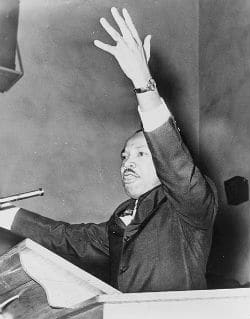
Martin Luther King, Jr. was an incredible orator, harnessing the power of words rather than weapons as he lead this country on its road to civil liberty. In fact, many of his speeches have the power of poetry, using some of the same conventions writers use when composing poems: alliteration, personification, simile, repetition, metaphor, and even rhyme. So, what better way to celebrate Martin Luther King Day than with words?
Here are some examples of poetry based activities you can do to commemorate Martin Luther King, Jr. on the third Monday of each January… or any time you feel so inspired!
Free verse is one of the simplest, and yet most difficult, type of poetry to write. While it doesn’t constrict the poet with rules about form, it requires him or her to work hard at creating a piece that is beautiful and meaningful without any specific guidelines about rhyme and meter. If you’d like to try your hand at free verse, there are a few tips (not rules) that will help as you develop your own style.
Choosing Words Carefully
Carefully chosen words can help you create a poem that sounds like the situation, emotion, or object you are trying to portray. For instance, short words with sharp consonants cause the reader to stop-and- go in a choppy cadence: Cut, bash, stop, kick, lick, bite, punch, jump, stick, kiss. They almost sound like what they mean. Use these types of short words when you want to show excitement, fear, anger, new love, or anything that might make your heart beat quickly. Longer words with soft sounds cause the reader to slow down. Use them when you want to show pause, tension, laziness, rest.
To provide the best experiences, we use technologies like cookies to store and/or access device information. Consenting to these technologies will allow us to process data such as browsing behavior or unique IDs on this site. Not consenting or withdrawing consent, may adversely affect certain features and functions.
Functional
Always active
The technical storage or access is strictly necessary for the legitimate purpose of enabling the use of a specific service explicitly requested by the subscriber or user, or for the sole purpose of carrying out the transmission of a communication over an electronic communications network.
Preferences
The technical storage or access is necessary for the legitimate purpose of storing preferences that are not requested by the subscriber or user.
Statistics
The technical storage or access that is used exclusively for statistical purposes.The technical storage or access that is used exclusively for anonymous statistical purposes. Without a subpoena, voluntary compliance on the part of your Internet Service Provider, or additional records from a third party, information stored or retrieved for this purpose alone cannot usually be used to identify you.
Marketing
The technical storage or access is required to create user profiles to send advertising, or to track the user on a website or across several websites for similar marketing purposes.
We use technologies like cookies to store and/or access device information. We do this to improve browsing experience and to show (non-) personalized ads. Consenting to these technologies will allow us to process data such as browsing behavior or unique IDs on this site. Not consenting or withdrawing consent, may adversely affect certain features and functions.
Functional
Always active
The technical storage or access is strictly necessary for the legitimate purpose of enabling the use of a specific service explicitly requested by the subscriber or user, or for the sole purpose of carrying out the transmission of a communication over an electronic communications network.
Preferences
The technical storage or access is necessary for the legitimate purpose of storing preferences that are not requested by the subscriber or user.
Statistics
The technical storage or access that is used exclusively for statistical purposes.The technical storage or access that is used exclusively for anonymous statistical purposes. Without a subpoena, voluntary compliance on the part of your Internet Service Provider, or additional records from a third party, information stored or retrieved for this purpose alone cannot usually be used to identify you.
Marketing
The technical storage or access is required to create user profiles to send advertising, or to track the user on a website or across several websites for similar marketing purposes.