Author: Kenn Nesbitt

Kenn Nesbitt, former U.S. Children's Poet Laureate, is celebrated for blending humor and heart in his poetry for children. Known for books such as "My Cat Knows Karate" and "Revenge of the Lunch Ladies," he captivates young readers globally.

How to Make a “Found Poem”

Visual artists sometimes talk about using “found objects” in their artwork. In other words, they collect interesting things during the course of a normal day (such as bus tickets, objects from nature, or a toy found on the street) and then find a way to incorporate those objects into their artwork.

Did you know that you can do the same thing with language? A “found poem” is created by collecting interesting text from the world around us and then using those words to make a poem. When you create poetry this way, you are acting like a documentary filmmaker—using scenes from real life to tell an interesting story.

Here are three simple and fun ways to create “found poetry” from the language that is all around you.

Classic Children’s Poetry on Poetry4kids.com

For many years, I’ve wanted to add some of my favorite classic children’s poems to Poetry4kids.com; the poems I read and had read to me as a child. I have always thought it would be a good idea to have an easy way for teachers, parents, and children to explore some of the most popular poems of the English language. Today, I finally accomplished that goal.

Poetry4kids.com now has a new Classics section where I have begun posting some of my favorite, and many of the most well-known poems written for children over the past few hundred years. For starters, these include such famous poems as Lewis Carroll’s “Jabberwocky,” Clement Moore’s “A Visit from St. Nicholas,” and Ernest Lawrence Thayer’s “Casey at the Bat.” I have posted 15 poems to start, and will continue posting more classic poems weekly, with the hope of eventually having hundreds of classic poems for you to enjoy.

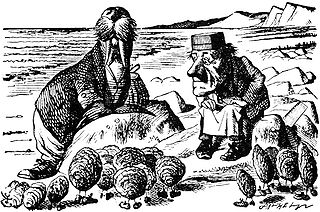
The Walrus and the Carpenter

Read and Rate Classic Poems

Even better, I have included the ability for readers to rate each poem (1-5 stars). The more highly-rated poems will appear at the top of the page, while the less popular poems will be farther down the page (or may get booted from the page altogether). This way you can easily see which poems are the most well-loved by readers, and even vote for your own favorites.

Suggest Your Favorite Classic Poems

Is there a classic children’s poem you would like to see added to the site? Send me an email and let me know, so I can be sure to post it.

Seven Ways to Encourage Your Child’s Interest in Writing

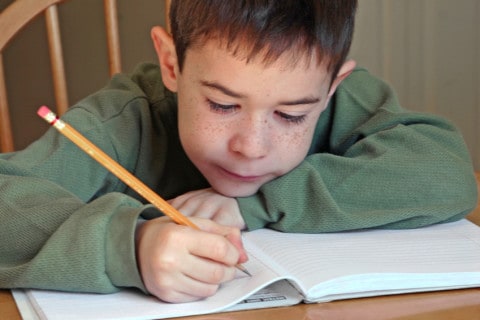
Boy WritingIf your child or teen has a burgeoning interest in being a writer, there are many ways to encourage this newfound interest. Here are seven suggestions for supporting the literary urge in young members of your family.

1: Offer your child fun writing tools

Your young poet or novelist will appreciate a field trip together to choose special writing tools. Depending on his or her personality, your child might prefer to write in a lined journal, in a blank art sketchbook, on monogrammed stationery, or even on neon-colored legal pads. He or she might like a set of colored gel pens, a set of fine-tipped Sharpie markers, or a fresh set of sharpened #2 pencils. See How to Start a Poetry Journal for ideas on different kinds of journals your child might prefer.

Some older kids or teens might prefer a digital environment for writing. But there are still ways to provide cool writing tools for a computer or mobile device. For example, you can download a free application at OmmWriter.com that is similar to Microsoft Word, but with a minimalist interface and relaxing music.

Children of all ages will enjoy seeing their finished poems or stories in print. It’s easy to create a poetry chapbook using a word processing program and your home printer. You can bind the book yourself with a hole punch and ribbon, or take it to a copy shop to be perfect-bound in order to look more like a “real book.”

How to Start a Poetry Journal

A journal is a place to express yourself, to record your thoughts, feelings and observations, and to cultivate your poetic style. The cool thing about your journal is that it’s yours. You can keep it secret or share it with your friends and family. You might even read some of your poetry out loud at a talent show or poetry jam. Whatever you decide to do with it, a daily poetry journal will keep you writing. And the more you write, the better writer you become!

Step One: Choose a journal that fits your style

Do you like to draw pictures and doodle around your poetry? If so, you might want a book with blank pages. Do you need help keeping your words in order? Then try a journal with lines, such as a spiral-bound notebook. If you write all day long whenever inspiration strikes, use a smaller book with a hard cover that you can tuck into your backpack, purse, or pocket.

Step Two: Organize your journal

While this is an important step, it will be different for everyone. You can divide your journal in several different ways:

  • Emotions: Joy, Anger, Sorrow, Humility, Pride
  • Seasons: Winter, Spring, Summer, Fall (add the different holidays within each season.)
  • Chronological: Just write the date at the top of the page.
  • Poetic Form: Acrostic, Cinquain, Clerihew, Diamante, Haiku, Limerick, Free Verse, etc.
  • Subject: Sports, Humor, Dance, Friends, Nature, School

Once you’ve decided how to organize your journal, use a paper clip, divider, sticky note, or colored tape to divide your sections. (You do not need to do this for a chronological journal.)

Step Three: Write!
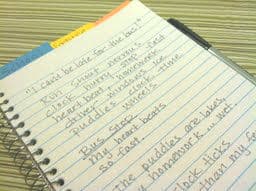
Poetry Journal

Jot down interesting words, phrases, sentences, or feelings on the page before starting your poem. This provides a jumping-off point for your thoughts.

For example, today I heard someone say, “I can’t be late for the bus!” So, I wrote that sentence on the top of a page in my “School” section.

Next, write down words that have to do with your phrase. For mine, I chose: Run, shout, nervous, hurry, stop, fast, heartbeat, homework, driver, windows, ice, puddles, clock, time, and wheels.

Then, decide what type of poem you want to write. For this one, I selected free verse.

Finally, use some of the words on your page to write your poem.

Bus Stop
My heart beats
so fast.

The puddles are lakes,
my homework… wet.

The clock ticks
faster than my feet
can run.

I shout to the driver,
“Stop!”

Wheels slow.
Take a breath.

I can’t be late for the bus.

Step Four: Keep it up!

It’s important to write in your journal on a regular basis. Finding a routine can help with that. Maybe you have quiet time at night before bed, when you’re riding on the bus, or at lunch break. Make it a part of your day, and soon you’ll have an entire journal full of incredible poetry!

How to Write a Backward Poem

Backward poems are one of the most fun types of poems to write. A “backward poem” is a poem in which everything is done in reverse of what you would usually expect. Often they are written about a “backward” person. For example, Shel Silverstein has a very famous poem called “Backward Bill” from his book A Light in the Attic, and Douglas Florian wrote a well-known poem called “Mr. Backward” in his book Bing, Bang, Boing. My poem “Mr. Brown the Circus Clown” from The Armpit of Doom is also an example of a backward poem.

Create a Backward Character

To write a backward poem, start by giving your backward person a name, such as “Backward Bill” or “Mr. Backward,” and maybe deciding where they are from. Then try rhyming the next line, like this:

Backward Bob from Backwardtown
is backward, flipped, and upside down.

Make a List of Backward Things

Now make a list of things that a backward person might do or say or have. For example, a backward person might wear his hat on his feet. Or he might have a cat that barks and a dog that meows. See if you can come up with several ideas like this and make a rhyming list, like this:

He wears his hat upon his feet
and wanders backward down the street.
His dog meows. His kitten barks.
His baby goldfish chases sharks.

You can add as many couplets (a “couplet” is two lines that rhyme) as you like to your list to make it as long as you want. For example, I thought of a few more things that Backward Bob might do:

His ears are blue. His nose is green.
He drives a purple submarine.
He eats his lunch when he’s asleep
and washes in a garbage heap.

Give Your Poem a Simple Ending

When you are writing a simple, descriptive poem – that is, a poem that describes someone or something, rather than telling a story – it’s okay to end your poem more or less the same way you started it. So you might write a couple of lines to end the poem like this:

And when he laughs he wears a frown.
He’s Backward Bob from Backward town.

Put it All Together

Once you’ve got your list and your beginning and end, just put it all together and, voila, you’ve got a shiny new backward poem, just like that.

Backward Bob

Backward Bob from Backwardtown
is backward, flipped, and upside down.
He wears his hat upon his feet
and wanders backward down the street.
His dog meows. His kitten barks.
His baby goldfish chases sharks.
His ears are blue. His nose is green.
He drives a purple submarine.
He eats his lunch when he’s asleep
and washes in a garbage heap.
And when he laughs he wears a frown.
He’s Backward Bob from Backwardtown.

Kenn Nesbitt
Follow Kenn

My Kitten Won’t Stop Talking

Podcast

Subscribe to this Podcast

My kitten won’t stop talking.
She just prattles night and day.
She walks around repeating
nearly everything I say.

My kitten never says, “Meow.”
She never even purrs.
She mimics me instead
in that annoying voice of hers.

She waits for me to speak,
and then she copies every word,
or begs me for a cracker,
or says, “I’m a pretty bird.”

I’m not sure what to do, and so
I simply grin and bear it.
She’s been this way since yesterday;
that’s when she ate my parrot.

–Kenn Nesbitt

Gerbil, Gerbil, On the Run

Podcast

Subscribe to this Podcast

Gerbil, gerbil, on the run
in your wheel, that looks like fun.
You must be in awesome shape.
Are you trying to escape?

Is that why you dug a hole?
Where’d you get that vaulting pole?
That looks like my grappling hook.
Give me back that rope you took.

Tell me what that ladder’s for.
Why’s that hacksaw on the floor?
Are those cable cutters there?
Do I see a signal flare?

Crowbar, blowtorch, chainsaw too?
What do you expect to do?
How’d you get that fuse to light?
Hey! That looks like dynamite!

Quick! Get out! It might explode!
Scram! Skedaddle! Hit the road!
Man, I’ll miss you. You were fun.
Gerbil, gerbil, on the run.

–Kenn Nesbitt

My Hamster Has a Skateboard

Podcast

Subscribe to this Podcast

My hamster has a skateboard.
When he rides it, though, he falls.
He takes off like a maniac
and crashes into walls.

He screams, “Geronimo!”
and then goes crashing down the stairs.
He’s good at knocking tables down
and slamming into chairs.

He’ll slalom through the living room
and then you’ll hear a, “Splat!”
which means that he’s collided with
my mother or the cat.

He plows right into cabinets,
and smashes into doors,
I think he’s wrecked on every bed
and every chest of drawers.

It’s fun to watch him ride
because you’re sure to hear a smash.
He doesn’t skate so well but, boy,
he sure knows how to crash.

–Kenn Nesbitt

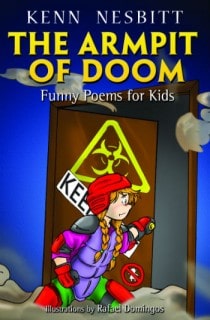
New Book! The Armpit of Doom: Funny Poems for Kids

The Armpit of Doom: Funny Poems for KidsMy newest poetry collection, The Armpit of Doom: Funny Poems for Kids, is now available! This collection of 70 new poems has been a labor of love for the past couple of years, and I hope you have as much fun reading it as I had writing it.

Click here to download a free sample in PDF format.

Click here to buy The Armpit of Doom from Amazon.com.

Book Description

Kids love Kenn Nesbitt’s hilarious poetry! With their rollicking rhythms, playful rhymes, and mischievous twists, kids can’t stop reading these poems.

The Armpit of Doom includes seventy new poems about crazy characters, funny families, peculiar pets, comical creatures, and much, much more, all whimsically illustrated by Rafael Domingos.

eBook Edition

In addition to the paperback, The Armpit of Doom is also available for Kindle, Nook, iOS, Google Play, and Kobo ereader. Click on the icons below for more information.

Buy Now on Amazon.comBuy Now on barnesandnoble.comBuy Now on iTunesBuy Now on Google PlayBuy Now on Kobo


Reviews

Irrepressible, unpredictable, and raucously popular children’s poet Kenn Nesbitt was spawned in the same cracked petri dish as Jack Prelutsky, to whom he is the natural heir. A title guaranteed to generate “No, wait, read this one!” responses, The Armpit of Doom is more mayhem from one of the masters.
(J. Patrick Lewis, U.S. Children’s Poet Laureate, author of Please Bury Me in the Library and many other books for children)

Welcome Back to School

Podcast

Subscribe to this Podcast

“Dear students, the summer has ended.
The school year at last has begun.
But this year is totally different.
I promise we’ll only have fun.

“We won’t study any mathematics,
and recess will last all day long.
Instead of the pledge of allegiance,
we’ll belt out a rock-and-roll song.

“We’ll only play games in the classroom.
You’re welcome to bring in your toys.
It’s okay to run in the hallways.
It’s great if you make lots of noise.

“For homework, you’ll play your Nintendo.
You’ll have to watch lots of T.V.
For field trips we’ll go to the movies
and get lots of candy for free.

“The lunchroom will only serve chocolate
and triple fudge sundaes supreme.”
Yes, that’s what I heard from my teacher
before I woke up from my dream.

–Kenn Nesbitt