
Poetry, Puns, and Prehistoric Joy
Every once in a while, a poetry book comes along that feels like pure kinetic energy on the page. That’s exactly the experience I had reading Dinos That Drive by Suzy Levinson, illustrated by Dustin Harbin. From the very first pages, it’s clear this is not a quiet, contemplative collection. This is a loud, lively, engine-revving celebration of dinosaurs, vehicles, and wordplay.
And really, what more do you need than that?
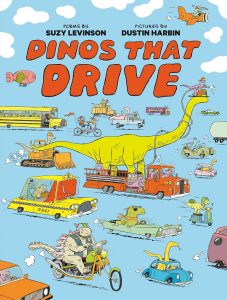
The premise is delightfully simple: dinosaurs are back, and not only are they alive and well, they’re driving everything from motorcycles and taxis to submarines and rocket ships. Each poem introduces a different dino, a different vehicle, and a different comedic scenario. The result is a collection that feels fast-paced, inventive, and consistently surprising.
Right from the opening spread, Levinson sets the tone with a kind of playful bravado. “You’ve never seen a dinosaur / that’s into driving cars?” she asks, before inviting readers to “buckle up” because “YOU AIN’T SEEN NOTHIN’ YET!” It’s an energetic kickoff that promises fun, and the book absolutely delivers on that promise.
What I appreciate most is how well the poems balance humor with strong poetic craft. These are not just jokes stretched into lines. Levinson clearly understands rhythm, rhyme, and pacing. Many of the poems have a musical quality that makes them perfect for reading aloud, whether in a classroom or at bedtime.
The wordplay is especially satisfying. Titles like “Triceratop-Down,” “Chomper-Chopper Traffic Report,” and “Iguano-Gone: A Sad Country Song” set the stage for clever twists and punchlines. In “Triceratop-Down,” for example, the humor comes from a simple but brilliant observation: horns and car roofs don’t mix. The payoff lands perfectly with the line about preferring “a topless jeep,” followed by horns that “go BEEP-BEEP!”
One of the things that makes this book especially appealing for educators is how seamlessly it blends poetry with bits of factual information. Throughout the book, short asides explain real dinosaur traits, pronunciation guides are included, and readers are given just enough scientific context to spark curiosity without slowing down the fun. It’s the kind of book that invites both laughter and learning.
A great example of Levinson’s style comes from “The Sweetest Dino,” a poem that captures her knack for combining humor, structure, and a perfectly timed twist:
The Sweetest Dino
Look! It’s Stegosaurus!
Can you believe our luck?
A dinosaur so friendly that
he drives an ice cream truck!But there’s a minor problem:
Steg forgot to pack!
No cones or cups! He’s just got plates —
they’re running down his back!
This is exactly the kind of poem that works on multiple levels. Kids will laugh at the visual joke, teachers will appreciate the clean rhyme and structure, and everyone will enjoy the clever connection between the Stegosaurus’s plates and the punchline. It’s simple, memorable, and very effective.
Visually, the book is just as energetic as the text. Dustin Harbin’s illustrations are packed with movement and detail. On the spread with the “Thunder Lizard” poem, for instance, a Brontosaurus roars across the page on a motorcycle, surrounded by other dinos on wheels, each one adding to the sense of chaos and fun. The art doesn’t just support the poems; it expands them, giving readers even more to discover on each page .
Another strength of the collection is its variety. Some poems lean into narrative, like the ongoing “Car-nivore” series featuring a not-so-trustworthy T. rex driver. Others play with sound effects and repetition, like “Velociraptor Velocity,” which builds momentum through quick, punchy lines that mirror the speed of a race. There are even stylistic shifts, such as the country-song parody in “Iguano-Gone,” which shows Levinson’s willingness to experiment while still keeping things accessible.
The pacing of the book also deserves mention. This is a collection that knows how to keep things moving. The poems are short, engaging, and arranged in a way that makes it very easy to read “just one more.” Before you know it, you’ve raced through half the book.
Perhaps my favorite thing about Dinos That Drive is its sense of joy. There’s no heavy message here, no attempt to be overly profound. Instead, it embraces the idea that poetry can be playful, silly, and full of imagination. It invites kids to laugh, to notice language, and maybe even to try writing their own dino-themed poems.
And that, in my mind, is exactly what a children’s poetry collection should do.
If you’re looking for a book that will get kids excited about poetry, make them laugh out loud, and maybe even inspire a few engine-sound effects during read-aloud time, Dinos That Drive is a fantastic choice. It’s lively, clever, and full of prehistoric personality.

- Book Review: Dinos that Drive - April 9, 2026
- Weekly Children’s Poetry Roundup – Saturday, April 4, 2026 - April 4, 2026
- Book Review: A Catalog of Curious Creatures - April 2, 2026