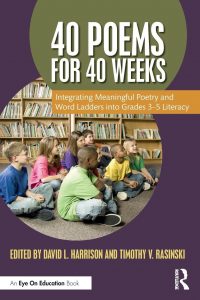
Yesterday I was delighted to see a new article appear on The Robb Review highlighting a book that I’m honored to be part of: 40 Poems for 40 Weeks: Integrating Meaningful Poetry and Word Ladders in Grades 3–5 Literacy, edited by children’s poetry champion David L. Harrison and literacy expert Tim Rasinski.
The article focuses on an idea I love: helping students learn not only about poems, but also about the poets who write them. As the authors point out, classrooms often celebrate authors of novels and chapter books, yet the people who create the poems students enjoy are sometimes less visible. Helping kids discover who poets are—what they were like as children, why they write poetry, and how they got started—can make poetry feel more personal and inspiring for young readers.
The book grew out of that philosophy. Harrison and Rasinski invited forty poets who write for children to contribute a poem along with a short, kid-friendly introduction about themselves. Each entry also includes an engaging literacy activity designed to help students interact with the poem in a meaningful way.
I was thrilled to be one of the poets included in the collection. My contribution is a tongue-twister poem called “Shelley Sellers.” If you’ve ever tried saying a tricky tongue twister faster and faster until everyone bursts out laughing, you already know why poems like this can be so much fun in the classroom. They’re playful, musical, and just challenging enough to make students want to try again and again.
That sense of repeated reading is actually one of poetry’s hidden superpowers. As the Robb Review article explains, poetry is especially powerful for building reading fluency, the bridge between decoding words and truly understanding what we read. When students rehearse a poem before performing or sharing it, they naturally practice rhythm, pacing, expression, and confidence.
Another feature I particularly like about this book is its structure. As the title suggests, it offers forty poems for forty weeks of the school year. Teachers can introduce one poem each week, creating a simple routine that keeps poetry alive in the classroom throughout the year. The poems can be read, discussed, performed, and explored alongside the word-ladder activities that accompany each selection.
I also love that the book introduces students to a wide variety of poets. Many kids already know classics like Shel Silverstein, Jack Prelutsky, or A. A. Milne, but the world of children’s poetry is much bigger than that. Giving students the chance to meet many different poets, see their photos, read about their lives, and enjoy their poems, can open doors for young readers and writers alike.
If you’re a teacher, librarian, or parent who enjoys sharing poetry with kids, this book is well worth exploring. It’s designed to fit easily into busy classroom schedules while helping students develop stronger reading skills and a deeper appreciation for poetry.
And if you happen to pick up a copy, be sure to see if you can say “Shelley Sellers” five times fast!